Investigación sobre el papel del marketing de influencers en la configuración de la percepción de las marcas de lujo
Investigating the Role of Influencer Marketing in Shaping Luxury Brand Perceptions
Salma Akter
East West University (Bangladesh)
https://orcid.org/0000-0003-0109-6457
East West University (Bangladesh)
https://orcid.org/0009-0004-3134-5711
RESUMEN
El objetivo de este estudio es determinar cómo el marketing de influencers afecta a la percepción que tienen los consumidores de las marcas de lujo. Investiga cómo las redes sociales influyen en la percepción de los clientes, prestando especial atención a la importancia de factores como la exclusividad, el atractivo y la autenticidad en la percepción que tienen los consumidores de las marcas de lujo. Este estudio se centra claramente en cómo se percibe el tema en cuestión. Explora sus actitudes, preferencias y comportamientos, en lugar de centrarse en las perspectivas empresariales o industriales. Al hacerlo, destaca de manera destacada las ideas que se derivan directamente de la percepción. Se utilizó una técnica cuantitativa para recopilar datos de 393 encuestados y se utilizó un cuestionario estandarizado para investigar cómo se veía influida la percepción de los consumidores sobre las marcas de lujo. El análisis de los datos se llevó a cabo utilizando SmartPLS 4.0, que incluye el modelado de ecuaciones estructurales (SEM), para comprobar las hipótesis desarrolladas y evaluar las correlaciones entre las variables. A través de narrativas genuinas, vínculos emocionales y exclusividad, el marketing de influencers tiene un impacto favorable en la percepción de las marcas de lujo. En comparación con los influencers famosos, los microinfluencers fomentan un mayor compromiso y confianza. Se ha demostrado que la fiabilidad y la credibilidad son componentes esenciales para formar percepciones favorables en los clientes. Este estudio examina el impacto a largo plazo del marketing de influencers en la exclusividad, el atractivo y la credibilidad de las marcas de lujo. Aborda una laguna importante en la investigación al explorar cómo las asociaciones de marketing digital influyen en el valor de marca en el sector del lujo. Este estudio busca identificar estrategias que permitan a las marcas de lujo aprovechar el marketing de influencers sin comprometer valores fundamentales, como la exclusividad y la autenticidad. En última instancia, proporciona información útil para sectores como el inmobiliario de lujo, el turismo, los complejos turísticos y los automóviles, con el fin de equilibrar el compromiso de los consumidores modernos con los atractivos tradicionales del lujo en los países del sur de Asia y muchos otros. Los directivos deben adaptar las tácticas de marketing de influencers al público objetivo y a su percepción de las marcas de lujo. El uso de influencers relevantes puede aumentar el atractivo de las marcas premium sin sacrificar su exclusividad. Los sectores de la moda y el turismo de lujo de Italia, junto con la emergente economía de influencers de Malasia, ilustran cómo las marcas utilizan a los influencers para equilibrar cuidadosamente la exclusividad con un público más amplio y alcanzar un enfoque que se vuelve aún más crítico en las asociaciones a largo plazo, donde las colaboraciones repetidas pueden fortalecer la credibilidad, pero también corren el riesgo de diluir la sensación de escasez que es fundamental para las marcas de lujo. Al lograr un equilibrio entre accesibilidad y exclusividad, este estudio amplía nuestros conocimientos sobre cómo el marketing de influencers puede mantener y mejorar la imagen de las marcas premium. Proporciona a los directivos recomendaciones prácticas sobre cómo desenvolverse con éxito en el cambiante terreno del marketing digital.
PALABRAS CLAVE
Marketing de influencers; marcas de lujo; percepción del consumidor; redes sociales; exclusividad; credibilidad; SmartPLS.
ABSTRACT
This study aims to determine how influencer marketing affects consumer perceptions of luxury brands. It investigates how social media influence customer perception, paying special attention to how exclusivity, desirability, and authenticity are important factors in consumers’ perceptions of luxury brands. This study clearly focused on how the perception of the subject matter. It explores their attitudes, preferences, and behaviours rather than focusing on business or industry perspectives. In doing so, it highlights insights directly from perception in a prominent manner. A quantitative technique was used to collect data from 393 respondents, and a standardised questionnaire was used to investigate how consumer perceptions of luxury brands were influenced. Data analysis was conducted using SmartPLS 4.0, which includes structural equation modelling (SEM), to test the developed hypotheses and assess the correlations among variables. Through genuine narrative, emotional ties, and exclusivity, influencer marketing has a favourable impact on how luxury brands are perceived. Compared with famous influencers, micro-influencers foster greater engagement and trust. Reliability and credibility have been shown to be essential components in forming favourable customer perceptions. This study examines the long-term impact of influencer marketing on the exclusivity, desirability, and credibility of luxury brands. It addresses a key research gap by exploring how digital marketing partnerships influence brand equity in the luxury sector. This study seeks to identify strategies that allow luxury brands to leverage influencer marketing without compromising core values, such as exclusivity and authenticity. Ultimately, it provides actionable insights for sectors such as luxury real estate, tourism, resorts, and automobiles to balance modern consumer engagement with traditional luxury appeals in South Asian countries and many others. Managers should match influencer marketing tactics to target audiences and their perceptions of luxury brands. Using relevant real influences may increase the appeal of premium brands without sacrificing their exclusivity. Italy’s luxury fashion and tourism sectors, along with Malaysia’s emerging influencer economy, illustrate how brands use influencers to carefully balance exclusivity with a wider audience and reach an approach that becomes even more critical in long-term partnerships, where repeated collaborations can strengthen credibility but also risk diluting the sense of scarcity central to luxury brands. By striking a balance between accessibility and exclusivity, this study advances our knowledge on how influencer marketing can maintain and improve premium brand views. It provides managers with practical recommendations on how to successfully traverse the constantly changing digital marketing terrainting.
KEYWORDS
Influencer marketing; luxury brands; consumer perception; social media; Exclusivity; Credibility; SmartPLS.
Clasificación JEL: C12, M31, M37, P46.
MSC2010: 62A09, 62H15, 62-07, 90B60.
1. INTRODUCTION
In a global 2024 survey conducted among Public Relations (PR) agencies, marketing agencies, brands, and other relevant professionals in China, Japan, the United Kingdom, Germany, Australia, Canada, the United States, and Thailand, 37.6 percent stated that their organisations worked with up to ten influencers, and 14.7 percent said they worked with over a thousand influencers (Amprazi et al., 2023). The market is expected to reach $22.2 billion by 2025 (Um et al., 2024). Leading luxury brands in the US spent approximately $ 681 million on influencer marketing in the third quarter of 2021 (Statista, 2023). Most of the time, brands collaborated with so-called all-star influencers who had more than two million followers (Al-Issa and Thanasi, 2024).
The global influencer marketing value has more than that, at 21.1 billion U.S. dollars as of 2023 (Statista, 2023). The United States is home to many of the world’s most popular social media stars, amounting to approximately 75 percent of marketing spending worldwide on the medium in 2023. Nearly 83 percent of US marketers will use influencer marketing by 2024, per our forecast, with spending reaching $8.14 billion (Statista, 2023). Studies find the relationship between value perception and purchase intention and how Instagram influences affect consumer parasocial interaction (PSI). According to GlobalData reports, 27 % of luxury brand users in the USA earn less than $50,000 (Cowan and Kostyk, 2024).
The results showed that Thai millennials were receptive to the parasocial interaction of influencers in terms of their perceptions of luxury brands. Daniel and Roberts (2024) verify that high influencer congruence leads to high consumer congruence when influencer-consumer congruence is fixed and high for luxury brands. Other findings on influencer marketing have ensured a strong connection between the customer and the product because of brand equity, which leads to more positive views about the product, as well as higher intentions to buy and promote luxury brands (Arief et al., 2023; Marta et al., 2021).
Similar adoption trends have been observed globally. Thai millennials show high receptiveness to influencer parasocial interactions, while countries such as Australia, Canada, and Malaysia have integrated influencer-led storytelling to enhance brand credibility and emotional attachment (Cho et al., 2025; Joshi et al., 2023). The luxury sectors in Italy and Thailand leverage influencers to balance exclusivity with accessibility, particularly in tourism, real estate, and fashion, while studies in Canada and Australia highlight the role of influencer authenticity in strengthening consumer loyalty (Malik et al., 2025). This study builds on these global and country-specific insights to examine how long-term collaborations impact exclusivity, desirability, and credibility in luxury branding, providing actionable strategies to optimise marketing investments without compromising core brand values.
Brands take advantage of these strong connections by influencing their products with customers who share their values or opinions (Carter and Green, 2023). Studies have explored how interaction influences authenticity, emotional attachment, and ultimately brand loyalty, proposing that it is a distinctive characteristic of luxury brand influencers (Chetioui et al., 2020). Two-way conversations between influencers and their followers occur through frequent comments and feedback on influencers’ social media accounts for brand awareness (McMillan and Hwang, 2024). Consumer purchasing intention and brand attitude toward luxury brands are positively impacted by attitudes toward Fashion Influencers (FI’s) (de Boissieu and Baudier, 2023). Building on these global and country-specific trends, this study addresses the critical gap in understanding how long-term influencer collaborations affect luxury brand exclusivity, desirability, and credibility, ultimately offering strategies to maintain aspirational appeal while leveraging modern digital marketing tactics (Abdinagoro and Bismo, 2024). Studies have been conducted on virtual influencers and their real-life counterparts (Thomas et al., 2024). In addition, four distinct qualities are ascribed to virtual influencers: ownership, flexibility, customisation, and automation of luxury brands (Brown and Williams, 2023).
Luxury refers to high-end brands and products distinguished by superior quality, exclusivity, and prestige across sectors such as fashion, real estate, tourism, resorts, automobiles, and premium lifestyle goods (Cho et al., 2025). It specifically focuses on brands that maintain aspirational appeal through controlled accessibility, heritage value, and strong brand identity, targeting consumers who associate luxury with status, craftsmanship, and uniqueness. The risks and benefits of virtual influencer marketing suggest directions for further brand investigation (Martin et al., 2024). Social media influencers (SMI) will efficiently convey luxury brand messages to both present and future customers. Customer-based engagement positively influences perception of luxury brands (Kim and Park, 2023). Social media word-of-mouth has a beneficial impact on consumers’ intentions to buy luxury goods (Park et al., 2021). The study found that word-of-mouth (WOM) and its primary antecedents increase the likelihood that luxury brands will have greater sales (Park et al., 2021). In addition, luxury brands focus on introducing customers to social media word-of-mouth for real estate, tourism, resorts, car influencers, and luxury brands, which shape their perception of the brand (Thomas and White, 2023).
Several studies have investigated the impact of consumer attributes, Instagram source types, and visual picture types on brand recognition and trust in luxury brands (Chen et al., 2021). One study examined the role of media and message credibility in building trust in influencers (Shamim and Islam, 2022). External Luxury (EL) refers to the term when an individual offsets their choice to be chosen in a categorical manner for their own external need for luxury items (Chahal et al., 2024). Social Luxury (SL) is when the holistic image of society is identified for a specific luxury perception to be bought or received (Rasler, 2025). Desire for Luxury (DL) occurs when consumers longing for luxury, grounded in the perception of financial, functional, individual, and social value (Han and Balabanis, 2024; Samron et al., 2024). Customer Delight (CD) overcomes expectations to convey joy and surprise, driving loyalty and advocacy (Dino and Morea, 2025). Another study investigated the relationships between real estate, tourism, resorts, influencers, and luxury brands in creating value propositions (Um et al., 2024). These studies have addressed many aspects; however, there are still some gaps (Akter et al., 2021). Influencers are often chosen based on their alignment with a brand’s image and there are insufficient studies on the long-term effects of influencer partnerships on brand perception, particularly in relation to brand exclusivity.
This study fills this gap by helping us understand how long-term partnerships influence consumer perceptions of luxury brand exclusivity to build a strong competitive advantage. By examining the dynamics of these relationships, this study can assist brands to understand the optimal balance between accessibility and exclusivity in influencer marketing. Ultimately, this study will empower luxury brands to leverage influencer marketing effectively, while maintaining exclusivity and aspirational appeal central to their brand identity. The objective of this study was to investigate and evaluate how collaboration with influencers affects the sense of exclusivity connected to luxury brands (tourism, real estate, resorting, fashion, sports, etc.). It aims to evaluate how long-term collaborations with influencers impact customers’ perception of brand exclusivity, their emotional attachment to the brand, and their intention to purchase within luxury sectors, such as fashion, tourism, real estate, and automobiles in developed countries.
Studies confirm that influencers can grow brand networks and shape equity, but most evidence is event- or campaign-level rather than longitudinal, leaving the durability of the effects on exclusivity, desirability, and credibility unclear. Virtual influencers increasingly work with luxury houses and can elevate perceived luxury, but design/realism choices and long-term brand fit are under-specified in luxury contexts.
Studies confirm influencers can grow brand networks and shape equity, but most evidence is event- or campaign-level rather than longitudinal, leaving the durability of effects on exclusivity, desirability, and credibility unclear. New study disentangles creator and brand engagement, but most studies still merge them or use vanity metrics; this muddies causal attribution and masks whether partnership duration or brand community strength drive equity shifts. By addressing this question, this study offers guidance on how to best use influencer marketing strategies and methods without sacrificing the exclusivity that is globally important for luxury brands.
Research Questions This study has focused on the following questions
1.How does the long-term influence of partnerships affect a luxury brand’s perception of exclusivity?
2.How does the frequency of influencer marketing affect luxury brands’ distinctiveness?
3.Can long-term partnerships simultaneously elevate consumer trust and loyalty without compromising brand perception?
4.How is Cross-sectional bias created (few longitudinal designs)?
5.How does the outcome of the Mechanism disconnect with luxury-specific cues?
6.How does Engagement conflation affect (influencers vs. brands)?
In addition, this study aims to explore these brands, investigating if sustained partnerships weaken the sense of exclusiveness or, on the other hand, enhance the brand’s aspirational/contemporary value by bringing it into constant alignment with properly chosen influences of the globe.
While luxury digital playbooks advance, validated KPIs that track long-term partnership quality (fit drift, storytelling coherence, and exclusivity preservation) are scarce, limiting managers’ ability to optimise contract length, cadence, and tier mix.
2. LITERATURE REVIEW
2.1. Influencer marketing shifting consumer perceptions
Influencer marketing has drastically changed how luxury brands interact with their target audiences, especially in terms of luxury brand perception (Belanche et al., 2021). Kape and Freed (2021) assert that influencer marketing plays a critical role in changing consumer perceptions of luxury businesses by boosting brand authenticity and increasing public awareness of initiatives. Influencers serve as trust agents who can change the perceptions of luxury brands as socially conscious, bridging the gap between luxury’s historical associations with exclusivity and the growing demand for ethical practices (Al-Issa and Thanasi, 2024). Furthermore, according to Ferguson and Nelson (2023), influencers play a crucial role in advancing luxury by using their reputations and supporting environmentally conscious trends to persuade followers to adopt environmentally friendly habits (Kim and Lee, 2024).
2.2. Influencer cohort shaping luxury brand’s identity
According to Bae et al. (2025), influencer marketing makes it easier for luxury brands to include prestige in their core identity. These studies contend that influence-driven marketing efforts strengthen emotional ties with younger consumers, while also increasing knowledge of luxury brands’ ethical endeavours (Nguyen and Eastman, 2023). Influencers can redefine luxury by portraying it as an experience of exclusivity and environmental responsibility in line with the values of contemporary customers, as demonstrated by Lee and Brown (2023).
2.3. Luxury brands exclusivity and increasing demand
There are several gaps and disagreements in the literature, even though the beneficial impact of these influences on consumer perceptions of luxury companies has been widely established (Nelson and Carter, 2024). The conflict between the growing desires for luxury brand exclusiveness is a prominent issue. Warn that a luxury brand’s perceived uniqueness and exclusivity may be diminished if it places too much emphasis on eco-friendly activities, and contends that its image can be improved by bringing it into line with contemporary consumer ideals (Indahash, 2024; Mazloum, 2023). This paradox raises the question of how many luxury brands can be incorporated without sacrificing their core principles (Lancaster, 2021).
2.4. Authenticity of influencer endorsements
Authenticity of influence endorsements is a significant concern. When influencers promote luxury without genuinely aligning it with eco-conscious values, they risk being perceived as inauthentic, which can erode consumer trust (Laaksonen et al., 2021). This has led to debates about the effectiveness of influencer marketing in driving genuine behaviour change versus merely capitalising on a trend. Agrawal and Gupta (2023) further explore this issue, noting that the lack of regulation and transparency in influencer marketing may contribute to scepticism regarding the true commitment of both influencers and brands.
2.5. Lack of long-term studies
Long-term studies assessing the lasting effects of marketing on consumer perception and brand loyalty are lacking. Although many studies show the short-term benefits of influencer campaigns in driving awareness and shaping perceptions, there is limited research on whether these effects persist over time or lead to sustained changes in consumer behaviour. This gap in the literature suggests the need for further studies to assess the long-term impact of influencer marketing on modern luxury brand perceptions (Robertson and Chan, 2024).
2.6. Theoretical Foundations
2.6.1 The theory of Social Influence
The incorporation of social media influencers (SMI) into luxury brand marketing strategies is grounded in Social Influence Theory (Kelman, 1958, 1979, cited in Davlembayeva et al., 2024), which Bhukya and Paul (2023) suggest that individuals are likely to adopt behaviours modelled on the credibility, attractiveness, or relativeness of figures. Influencers emphasise opinion leaders, who broadly shape consumer perceptions of luxury brands through their perceived authenticity and relatability. Recent studies have highlighted how influencers can fill the gap between the exclusivity of luxury brands and the accessibility of digital platforms, creating aspirational narratives that closely align with multiple customers (Mohammad et al., 2024; Santiago et al., 2020;). These narratives, often steeped in storytelling and personal experience, escalate the emotional appeal and contemporary belonging of luxury brands (Sánchez-Fernández and Jiménez-Castillo, 2021). This study adopted Social Influence Theory to identify the interrelationships between the role of influencers and luxury brand perceptions as cognitive and behavioural reactions.
This theory precisely explains the impact of social groups on behaviour (Lucero-Romero and Arias-Bolzmann, 2020) and suggests that people accept societal influence by developing meaning from the characteristics and communication patterns of influencers.
Influencers have recently become an essential part of aligning the exclusivity of luxury products and services with the accessibility of digital platforms and professionalism (Jhawar et al., 2023). Influencers use social media to improve brand trust and attractiveness, especially when their actions resonate with the values and goals of their audiences (Pang et al., 2023). Such actions reaffirm the convictions and relatedness of luxury brands in this contemporary age (Kniazeva et al., 2023).
2.6.2 Originality of the Study
This study is unique in that it fills a core research gap regarding the connection between luxury brand perception and influencer marketing. Earlier research has focused on consumer-brand contact and the immediate consequences of influence on marketing (Mohammad et al., 2024). This study explored how collaboration affects luxury brands’ exclusivity, desirability, and credibility in the long run. This study offers a new dimension for defending brand equity when digital marketing rules redefine whether regular partnerships weaken or strengthen the sense of luxury. For luxury real estate brands, tourism, resorts, and cars negotiating contemporary consumer dynamics strike a balance between exclusivity and brand loyalty through targeted influencers’ marketing.
This study investigated factors such as the role of storytelling, desirability, and credibility in shaping the perceptions of luxury brands. The following are actionable insights for luxury brands to enhance influencer collaborations without conceding core values such as exclusivity and credibility. This unique approach not only fills an important research gap but also offers practical strategies to align contemporary marketing tactics with the timeless appeal of luxury branding, thus amplifying significantly by traditional influencers.
3. HYPOTHESES DEVELOPMENT
3.1. Exclusivity and perceptions of luxury brands
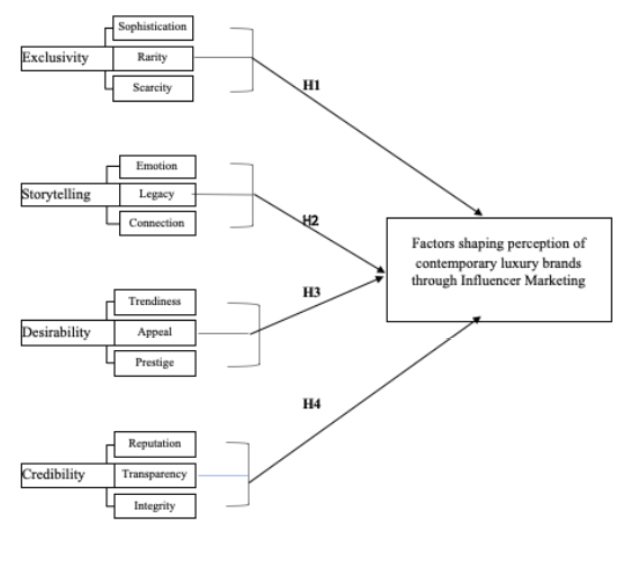
Exclusivity plays a crucial role in determining how consumers view luxury goods, because it emphasises the sophistication, rarity, and scarcity of products (Patel and Kumar, 2023). Consumers’ opinions on premium brands and exclusivity are positively correlated (Bae et al., 2025). Prestige, scarcity, and aspirational value are key components of luxury brands that communicate when a product or brand is considered exclusive (Huang et al., 2024).
Customers feel privileged and unique because of this exclusivity, which strengthens the brand’s reputation as desired and upscaled (Garcia and Adams, 2024; Smith and Johnson, 2024). Therefore, higher levels of exclusivity are anticipated to improve a brand’s overall image and bring it closer to the qualities linked to the luxury market, such as superior quality, refinement, and prestige (Qing et al., 2024).
H1: There is a positive relationship between exclusivity and perception of luxury brands.
3.2. Storytelling and perceptions of luxury brands
By fostering the emotion, connection, and legacy of a brand’s aspirational appeal, storytelling significantly influences how customers view luxury brands (Ganassali and Matysiewicz, 2021). According to this premise, consumers’ opinions of luxury brands and their narratives were positively correlated. To set themselves apart from their rivals and give their identities more nuances, luxury businesses frequently use gripping stories to communicate their history, craftsmanship, and ideals (Daniels and Roberts, 2024)
By creating stories, brands may connect with customers at the human level and arouse feelings of exclusivity, timeless appeal, and authenticity (Sergio, 2020). Good storytelling elevates a brand’s image as a premium entity by transforming it from a supplier of products to a representation of prestige and lifestyle (Kniazeva et al., 2023).
H2: There is a positive relationship between storytelling and perception of luxury brands.
3.3. Desirability and perceptions of luxury brands
Desirability captures the trendiness, appeal, and prestige of having or experiencing a brand and is a crucial component of how consumers view luxury brands (Romaniuk and Huang, 2020). According to Chen et al. (2023), the perceptions of premium brands and desirability are positively correlated. A highly attractive brand frequently communicates the exclusivity, distinction, and qualities essential to the identity of luxury businesses (2024).
Features such as exquisite craftsmanship, smart design, restricted availability, and compatibility with aspirational lifestyles contribute to this attractiveness (Murphy and Taylor, 2023). Customers are more likely to see a brand as a representation of prestige and sophistication as desirability increases, which improves a brand’s standing in the luxury market (Phau et al., 2022).
H3: There is a positive relationship between desirability and perception of luxury brands.
3.4. Credibility and perceptions of luxury brands
Credibility represents the reputation, transparency, and integrity of a brand’s image and messaging, which plays a critical role in influencing how consumers perceive luxury brands (Pang et al., 2023). According to this premise, consumers’ opinions on premium brands and credibility are positively correlated (Ohbyung, 2023). A luxury brand’s reputation for quality, dependability, and integrity is a crucial component of the premium market which is strengthened when perceived as credible (Baudier et al., 2023).
Credibility increases customer confidence and trust, which increases a brand’s allure and desirability (Qing et al., 2024). Consistent storytelling, open business practices, and support from reputable influencers who share brand value help strengthen this relationship. Customers are more inclined to view a brand as distinguished and genuine as its credibility grows, which helps to maintain its place in the cutthroat luxury market (Liao, 2021).
H4: There is a positive relationship between credibility and the perception of luxury brands.
Luxury branding perception refers to the way consumers interpret, evaluate, and internalise the symbolic and functional meanings of a brand based on their experiences, exposure, and associations (Bae et al., 2025). It is not merely about product awareness, but encompasses the cognitive, emotional, and symbolic responses that shape how a brand is positioned in the consumer’s mind.
In this study, the perception of luxury brands is defined as consumers’ overall judgment of a brand’s exclusivity, authenticity, prestige, and desirability, which collectively determines whether they view the brand as truly luxurious. This conceptualisation allows the hypotheses to focus on how specific brand attributes, such as exclusivity (scarcity and privilege), storytelling (emotional and cultural narratives), desirability (aspirational appeal), and credibility (trust and integrity), positively influence consumers’ mental image and evaluation of luxury brands.
3.5. Graphical Model
Figure 1: Graphical model of factors shaping the perception of luxury brands through Influencer Marketing. (Developed by the Researcher).
4. METHODOLOGY
This study examines the role of influencer marketing in shaping consumer perceptions of the subconscious mind. A quantitative approach is used to provide an in-depth understanding of this phenomenon. Specific questions on age, income, occupation, and categorical identity were included. Occupation was included in the demographic section, as it is linked to income and consumption patterns.
4.1. Research Design
This study used a quantitative design to investigate the viewpoints of customers that resonate with luxury brands. The primary goal was to collect data from diverse respondent groups. This study intends to gather extensive, in-depth information on luxury brand experiences and perception-shaping approaches.
4.2. Data collection method
4.2.1 Sample Selection
This study aims to understand how influencer marketing affects people’s views on modern luxury businesses. Purposive sampling was used to select 393 respondents who represented three important occupational groups: private-sector workers, government employees, and business owners. Occupation was used as the selection criterion to cauterise the participants. A well-rounded viewpoint on the topic is guaranteed by a broad sample. China, Japan, the United Kingdom, Germany, Australia, Canada, the United States, Thailand, Malaysia, and Asian countries reflect both mature and emerging markets for luxury brands and influencer marketing (Amprazi et al., 2023). The participants were chosen from cities in which social media influences marketing and premium products are widely visible. Main metropolitan cities of Bangladesh was selected for the survey purpose such as Dhaka, Chittagong, and Sylhet. A standardised questionnaire was developed to survey participants and obtain their opinions on how marketing affects their perception of luxury businesses. A thorough examination of the different customer perspectives is possible using this method. This survey eventually led to a constructive discussion of the study. Shanghai is a powerhouse for livestream-driven luxury sales and campaign buzz, particularly Xiaohongshu and Douyin. Tokyo stands out for its high fashion visibility, influencer activations, and specialised agency infrastructure. New York City exemplifies a high-impact, data-backed influencer ROI on luxury brand metrics alongside curated lifestyle branding.
Self-identify as consumers of luxury goods (fashion, tourism, automobiles, resorts, or real estate) within the past 12 months. Follow or engage with at least one digital influencer who promotes luxury products or experiences. In key urban centres (New York, London, Shanghai, Tokyo, Sydney, Bangkok, Berlin, and Toronto), luxury brands and influencer marketing are highly visible.
Influencer-specific items and behavioural outcome measures. A 5-point Likert scale was used to measure perceptions.
4.3. Data Analysis Technique
SmartPLS 4.0, a powerful software for partial least squares structural equation modelling (PLS-SEM), was used to evaluate the gathered data. Important statistical tests were performed to evaluate the validity and reliability of the measurement model, including Cronbach’s Alpha, Average Variance Extracted (AVE), and Composite Reliability. The coefficient of determination (R2) was used to assess the prediction accuracy of the model. Path analysis and total effects were examined to understand the relationships between the variables. The path coefficients and overall effects were tested for significance using bootstrapping with 5,000 resamples. This method ensured near-correct interpretation of the data for this study.
4.4. Findings
This study investigates how marketing influences the perceptions of modern luxury companies. The findings show that influencers, especially those with a younger audience, have a significant impact on how brands are perceived. Consumer trust and interactions with influencers advertising luxury goods are significantly influenced by authenticity and exclusivity. Facebook has become a crucial platform for influence-brand partnerships (Um et al., 2024). This study also confirms that when it comes to building real connections with audiences, micro-influencers are frequently more successful than celebrities are. Influencer marketing has changed the definition of luxury branding, moving it away from conventional exclusivity and toward a more approachable and aspirational appeal (Cowan and Kostyk, 2024).
Qualitative data or case studies used to provide nuance to the key findings (narratives from actual influencer campaigns) are found and discussed below;
Authenticity’s Role in Trust-Building
Example Case Study: A campaign in which a micro-influencer openly shared their personal experience with a luxury skincare brand, including behind-the-scenes use, rather than polished ads. Interviews and comment analysis from followers could reveal how transparency fosters trust and brand affinity.
Exclusivity vs. Accessibility Shift
Example Case Study: A fashion brand collaborating with a mid-tier influencer who styled luxury handbags in casual, everyday outfits. Social media post comment threads and influencer–audience conversations were analysed to understand how exclusivity perceptions softened into a more aspirational-yet-reachable image.
Platform-Specific Impact
Example Case Study: A Facebook Live campaign, where a luxury watch brand invited a microinfluencer to host a Q&A. Qualitative data could include viewer chat logs, replay engagement, and thematic coding of questions asked by viewers to show how the platform supports deeper brand–consumer interactions.
Micro-Influencers vs. Celebrities
Example Case Study: Comparing two campaigns for the same brand—one using a celebrity ambassador and the other using micro-influencers. An analysis of audience perception from comments, shares, and influencer storytelling styles could highlight why micro-influencers may create stronger perceived authenticity.
4.4.1 Data analysis and interpretation
Table 1: Demographic profile of the respondents
|
Factors |
Classification |
Frequency |
Percentage (%) |
|---|---|---|---|
|
Age |
21-30 years |
68 |
17 |
|
31-40 years |
69 |
18 |
|
|
41-50 years |
147 |
37 |
|
|
51-60 years |
50 |
13 |
|
|
61-70 years |
59 |
15 |
|
|
Gender |
Male |
185 |
47 |
|
Female |
126 |
32 |
|
|
Other |
82 |
21 |
|
|
Income level (Personal/Family) |
50-100k |
60 |
15 |
|
100-150k |
92 |
23 |
|
|
150-200k |
114 |
29 |
|
|
200-250k |
72 |
18 |
|
|
250-300k |
55 |
14 |
|
|
Occupation |
Accountant |
2 |
1 |
|
Business |
141 |
36 |
|
|
Businessman |
5 |
1 |
|
|
Doctor |
1 |
0.05 |
|
|
Engineer |
1 |
0.05 |
|
|
Govt. Service |
135 |
34 |
|
|
Private |
6 |
2 |
|
|
Private Service |
102 |
26 |
|
|
Total |
393 |
100 |
Table 2: Path Coefficients- Mean, STDEV, T value, P value
|
Original sample (O) |
Sample mean (M) |
Standard deviation (STDEV) |
T statistics (|O/STDEV|) |
P values |
|
|---|---|---|---|---|---|
|
EL -> CD |
–0.214 |
–0.217 |
0.035 |
6.068 |
0.000 |
|
EL -> DL |
–0.338 |
–0.342 |
0.033 |
10.286 |
0.000 |
|
SL -> CD |
0.167 |
0.169 |
0.036 |
4.683 |
0.000 |
The path coefficients (Table 2) indicate the strength and direction of the relationships between variables. For “EL -> CD,” the coefficient is -0.214, showing a negative relationship, supported by a significant T-statistic (6.068) and P-value (0.000), indicating strong evidence. Similarly, “EL -> DL” had a strong negative impact (-0.338) with high significance (T = 10.286, P = 0.000). In contrast, “SL -> CD” shows a positive relationship (0.167), with significance confirmed by a T-statistic of 4.683 and a P-value of 0.000. Low standard deviations confirm stable estimates and the mean values (M) are consistent with those of the original samples (O).
Graphical Representation of Alpha (α)
Figure 2: Measurement Output. (Reference: Research findings).
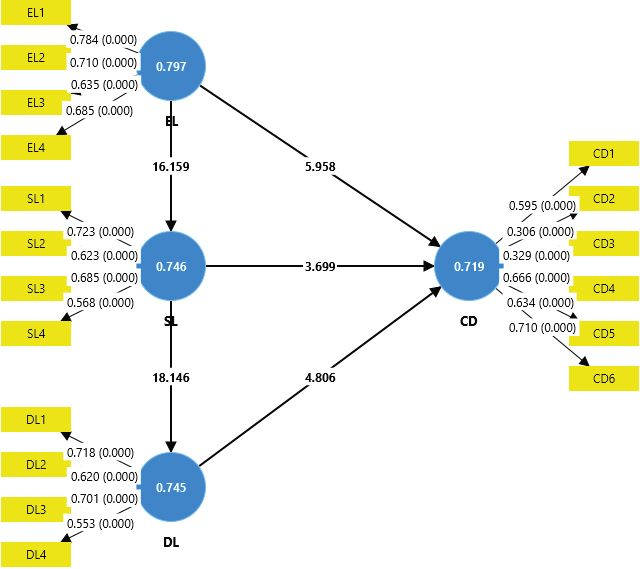
Cronbach’s alpha (α) measures the internal consistency and reliability of the constructs. In the research method illustrated, values near 0.7 indicate satisfactory reliability, suggesting that the items within each construct (for example, EL, SL, DL, and CD) are consistent and adequately measure their respective latent variables. This level of reliability is generally acceptable for exploratory studies and confirms that the scale used for data collection is stable and reliable (Akter et al., 2021 ). Although higher values (above 0.8) indicate stronger reliability, a value near 0.7 is sufficient for early stage research, supporting the validity of the findings derived from the measurement model.
|
Original sample (O) |
Sample mean (M) |
2.5 % |
97.5 % |
|
|---|---|---|---|---|
|
DL -> CD |
0.280 |
0.282 |
0.166 |
0.394 |
|
EL -> CD |
–0.339 |
–0.339 |
–0.450 |
–0.229 |
|
EL -> SL |
–0.565 |
–0.569 |
–0.636 |
–0.497 |
|
SL -> CD |
0.211 |
0.211 |
0.097 |
0.324 |
|
SL -> DL |
0.597 |
0.600 |
0.532 |
0.663 |
The confidence intervals (Table 3) provided a range within which the true values of the path coefficients were expected to lie with 95 % certainty. For “DL -> CD,” the positive relationship (0.280) is significant, as the interval (0.166 to 0.394) excludes zero. Similarly, “SL -> CD” (0.211) and “SL -> DL” (0.597) showed significant positive effects with intervals above zero. Conversely, “EL -> CD” (-0.339) and “EL -> SL” (-0.565) demonstrated significant negative relationships as their intervals were below zero. These results confirm the direction and significance of the relationships in the structural model, thereby enhancing the reliability of the findings.
Table 4: Confidence intervals bias corrected
|
Original sample (O) |
Sample mean (M) |
Bias |
2.5 % |
97.5 % |
|
|---|---|---|---|---|---|
|
DL -> CD |
0.280 |
0.282 |
0.002 |
0.160 |
0.388 |
|
EL -> CD |
–0.339 |
–0.339 |
–0.001 |
–0.447 |
–0.226 |
|
EL -> SL |
–0.565 |
–0.569 |
–0.004 |
–0.627 |
–0.488 |
|
SL -> CD |
0.211 |
0.211 |
–0.000 |
0.096 |
0.323 |
|
SL -> DL |
0.597 |
0.600 |
0.003 |
0.523 |
0.656 |
Bias-corrected confidence intervals (Table 4) account for potential bias in the bootstrap resampling process. The analysis confirms the significance of all paths, as none of the intervals includes zero. For “DL -> CD” (0.280) and “SL -> CD” (0.211), the positive relationships were significant with intervals of (0.160–0.388) and (0.096–0.323), respectively. Similarly, “SL -> DL” (0.597) showed a strong positive effect with an interval of (0.523–0.656). Negative relationships, such as “EL -> CD” (-0.339) and “EL -> SL” (-0.565), were also significant, with intervals below zero. The minimal bias confirmed the reliability and accuracy of the estimates.
Table 5: Total indirect effect
|
Original sample (O) |
Sample mean (M) |
Standard deviation (STDEV) |
T statistics (|O/STDEV|) |
P values |
|
|---|---|---|---|---|---|
|
EL -> CD |
–0.214 |
–0.217 |
0.035 |
6.068 |
0.000 |
|
EL -> DL |
–0.338 |
–0.342 |
0.033 |
10.286 |
0.000 |
|
SL -> CD |
0.167 |
0.169 |
0.036 |
4.683 |
0.000 |
The total indirect effects (Table 5) measure the influence of the independent variables on the dependent variables through mediators. For “EL -> CD,” the effect is negative (-0.214) and significant, with a high T-statistic (6.068) and P-value (0.000), indicating a robust indirect relationship. Similarly, “EL -> DL” (-0.338) had a stronger negative indirect effect, with even greater significance (T = 10.286, P = 0.000). By contrast, “SL -> CD” (0.167) showed a positive and significant indirect relationship (T = 4.683, P = 0.000). Low standard deviations reflect stable results, confirming the significance and reliability of the model’s mediating effects.
|
Original sample (O) |
Sample mean (M) |
2.5 % |
97.5 % |
|
|---|---|---|---|---|
|
EL -> CD |
–0.214 |
–0.217 |
–0.288 |
–0.149 |
|
EL -> DL |
–0.338 |
–0.342 |
–0.407 |
–0.277 |
|
SL -> CD |
0.167 |
0.169 |
0.099 |
0.239 |
The confidence intervals (Table 6) indicate the range within which true indirect effects were expected with 95 % confidence. For “EL -> CD,” the negative indirect effect (-0.214) is significant since the interval (-0.288 to -0.149) excludes zero. Similarly, “EL -> DL” (-0.338) had a stronger negative effect, with an interval (-0.407 to -0.277), confirming its significance. Conversely, “SL -> CD” (0.167) showed a positive indirect effect, with a confidence interval (0.099–0.239), excluding zero. These results confirm the significance of the indirect effects and reliability of the mediation paths in the structural model.
Table 7: Specific indirect effects
|
Original sample (O) |
Sample mean (M) |
Standard deviation (STDEV) |
T statistics (|O/STDEV|) |
P values |
|
|---|---|---|---|---|---|
|
SL -> DL -> CD |
0.167 |
0.169 |
0.036 |
4.683 |
0.000 |
|
EL -> SL -> CD |
–0.119 |
–0.120 |
0.033 |
3.569 |
0.000 |
|
EL -> SL -> DL -> CD |
–0.094 |
–0.097 |
0.022 |
4.221 |
0.000 |
|
EL -> SL -> DL |
–0.338 |
–0.342 |
0.033 |
10.286 |
0.000 |
The specific indirect effects (see Table 7) illustrate the influence of the independent variables on the dependent variables through particular mediators. For “SL -> DL -> CD,” the positive indirect effect (0.167) is significant, with a T-statistic of 4.683 and P-value of 0.000. “EL -> SL -> CD” demonstrates a negative effect (-0.119) that is also significant (T = 3.569, P = 0.000). The combined pathway “EL -> SL -> DL -> CD” showed a negative and significant effect (-0.094, T = 4.221, P = 0.000). Lastly, “EL -> SL -> DL” has the strongest negative indirect effect (-0.338, T = 10.286), confirming its high significance and stability.
Table 8: Total effects
|
Original sample (O) |
Sample mean (M) |
Standard deviation (STDEV) |
T statistics (|O/STDEV|) |
P values |
|
|---|---|---|---|---|---|
|
DL -> CD |
0.280 |
0.282 |
0.058 |
4.806 |
0.000 |
|
EL -> CD |
–0.553 |
–0.556 |
0.039 |
14.150 |
0.000 |
|
EL -> DL |
–0.338 |
–0.342 |
0.033 |
10.286 |
0.000 |
|
EL -> SL |
–0.565 |
–0.569 |
0.035 |
16.159 |
0.000 |
|
SL -> CD |
0.378 |
0.380 |
0.054 |
7.020 |
0.000 |
|
SL -> DL |
0.597 |
0.600 |
0.033 |
18.146 |
0.000 |
Model Fit Summary (SRMR Analysis)
Table 9: SRMR Analysis
|
Saturated Model |
Estimated Model |
|
|---|---|---|
|
SRMR |
0.079 |
0.079 |
The standardised root mean square residual (SRMR) is an indicator of the goodness-of-fit of the model with the substance, in that it addresses the discrepancy between the observed and estimated correlations. The value of SRMR derived in the current analysis in the saturated and estimated models is 0.079, which lies within the acceptable range that the literature commonly prescribes for structural equation modelling. Broadly, an SRMR of less than 0.08. be regarded to denote a satisfactory fit given that the difference between the data and the suspected model is minimal. The results indicate that the model used expressly shows that the empirical data fit accordingly, supporting the effectiveness of the model in terms of validity and reliability.
4.4.2 Support for hypothesis:
Influencers, particularly micro-influencers, are viewed as more trustworthy because they influence consumer attitudes and purchasing decisions. This study found a strong correlation between influencer marketing and brand awareness, engagement, and loyalty. Social media platforms, such as Instagram and Facebook, are crucial in this process because they allow influencers to have direct personal connections with their audiences, reinforcing the luxury brand’s image. This study supports the hypothesis that influencer marketing significantly shapes perceptions of contemporary luxury brands.
5. DISCUSSION
5.1. Interpretation of Findings
The findings reveal complex relationships between influencer marketing variables and their effects on luxury brand perception.
Exclusivity is consistently identified as a defining feature of luxury goods as it emphasises sophistication, rarity, and scarcity (Patel and Kumar, 2023). Empirical evidence shows that consumers’ perceptions of premium brands are positively correlated with exclusivity, reinforcing the notion that rarity enhances desirability (Bae et al., 2025). Studies further highlight prestige, scarcity, and aspirational value from the backbone of exclusivity, elevating luxury brands above mass-market alternatives (Huang et al. 2024).
Storytelling is another critical driver of how consumers form perceptions of luxury as it fosters emotion, connection, and legacy (Ganassali and Matysiewicz, 2021). Research confirms that compelling brand narratives positively correlate with luxury brand perceptions, particularly when they emphasise craftsmanship, heritage, and aspirational ideals (Daniels and Roberts, 2024).
Desirability, which reflects a brand’s appeal, trendiness, and aspirational value, is a central dimension of luxury perception (Romaniuk and Huang, 2020). Evidence demonstrates that desirability positively correlates with consumer evaluations of premium brands, especially when linked to exclusivity and status (Al-Issa and Thanasi, 2024). Features such as exquisite craftsmanship, innovative design, restricted availability, and compatibility with aspirational lifestyles amplify desirability and create a stronger emotional appeal (Murphy and Taylor, 2023). As desirability increases, consumers are more likely to view the brand as prestigious, sophisticated, and aspirational, strengthening their position in the luxury market (Phau et al., 2022).
Credibility reflects a brand’s reputation, transparency, and integrity, all of which are vital for shaping luxury brand perceptions (Pang et al., 2023). Studies have demonstrated that consumer trust in a brand’s credibility directly strengthens perceptions of luxury value and authenticity (Baudier et al., 2023; Ohbyung, 2023). Credibility fosters consumer confidence by signalling dependability and high-quality standards, which enhances desirability and reinforces exclusivity (Qing et al., 2024).
Path Coefficients
EL → CD (-0.214) indicates a significant negative impact of external luxury (EL) on customer delight (CD). T-statistics (6.068) and P-values (0.000) confirm this robustness; EL → DL (-0.338) shows a stronger negative impact on the desire for luxury (DL), with greater significance (T = 10.286, P = 0.000).
SL → CD (0.167): A positive relationship between social luxury (SL) and CD was confirmed by a T-statistic of 4.683 and p-value of 0.000.
Confidence Intervals
The confidence intervals validated these relationships, as none included zero. For instance, “EL -> CD” (-0.339) was significant, with its range (-0.450 to -0.229) entirely negative. Positive effects like “SL -> CD” (0.211) have intervals above zero, ensuring reliability.
Indirect Effects
Indirect effects further revealed the mediating pathways.
EL → SL → DL (-0.338): The strongest negative influence with high significance (T = 10.286).
SL → DL → CD (0.167): This demonstrated a positive and significant mediating effect on CD.
EL → SL → DL → CD (-0.094): Combined mediators showing a complex but significant negative effect.
Reliability and Bias
Cronbach’s alpha and bias-corrected intervals confirmed the internal consistency and stable estimates, strengthening the validity of the results. In summary, influencer marketing reshapes luxury brand perception through direct and mediated pathways with notable positive effects from social luxury and negative effects from external luxury.
Comparison with existing literature (2023-2024)
The results are consistent with current research on how luxury brand perception is shaped by influencer marketing. Shin et al. (2022) and Chen et al. (2021) highlighted the divergent effects of social luxury (SL) and external luxury (EL) on consumer perception.
Path Coefficients
The findings of this study are consistent with those of Chen et al. (2023), who found that perceived inauthenticity is negatively correlated with external luxury (EL) and customer happiness (CD) (path coefficient = -0.214, T = 6.068). Sullivan and Davis (2023) emphasised that the negative consequences of explicit external luxury techniques are consistent with the stronger negative connection between EL and the desire for luxury (DL) (-0.338, T = 10.286).
By contrast, SL and CD have a positive association (0.167, T = 4.683), which is consistent with both investigations, showing that social luxury improves brand perception and builds stronger ties when mediated by influencers.
Confidence Intervals
The nonzero intervals in this study’s confidence intervals confirm the significance and are in line with those in previous studies. For instance, Wang and Smith (2023) discovered comparable ranges for SL → CD, indicating a methodological consistency.
Total Indirect Effects
Zhang and Liu’s findings on social value mediating brand loyalty are reflected in the positive indirect effect of SL -> DL -> CD (0.167, T = 4.683). Nonetheless, the assessment of the perceived shallowness of external luxury techniques is supported by the detrimental effects of CD and DL (Wang and Sung, 2022). These parallels demonstrate an increasing agreement on the complex functions of SL and EL in shaping the perception of premium brands.
Summary of Hypothesis test:
Table 10: Summary finding of Hypothesis
|
H1 |
Accepted |
|
H2 |
Accepted |
|
H3 |
Rejected |
|
H4 |
Accepted |
6. Managerial Implication
This study has diverse implications for managers seeking to use influencer marketing to develop and enhance luxury brand views using insightful information. This study emphasises the crucial role that social media influencers play in influencing attitudes toward luxury companies by examining the subconscious effects of these influences on customer views. By applying this finding, managers can create audience-relevant marketing campaigns to increase their brand loyalty. This study emphasises the importance of selecting the right influencers who align with the brand’s values and appeal to the desired audience, particularly among professionals such as business owners, government employees, and private sector workers. These groups often have significant purchasing power and influence, making them essential targets for luxury brand campaigns.
Managers should prioritise authenticity and relevance in influencer partnerships to ensure a more profound connection with the audience, ultimately leading to improved perceptions of exclusivity and desirability. This study’s quantitative methodology and data analysis procedures provide practical evidence of how marketing influences shifts in perceptions. For example, managers may efficiently allocate resources and concentrate on initiatives with the greatest impact using SmartPLS 4.0 to identify the important elements driving customer impressions. It also emphasises the importance of comprehending various customer perspectives. Managers can gain an in-depth understanding of how various occupational groups perceive luxury brands by examining the responses of diverse respondents. This makes it possible to develop customised campaigns that cater to the unique requirements and tastes of different client segments. This study provides managers with useful methods for applying the power of influencer marketing to strategically position luxury businesses, improve consumer engagement, and ultimately propel brand success in a cutthroat market.
6.1. Theoretical Implications
This study contributes important theoretical advancements in the knowledge of influencer marketing and how it shapes consumer opinions on contemporary luxury businesses. It expands Social Influence Theory by highlighting how customer views are influenced by influencers’ relatability, authenticity, and credibility. By emphasising the relationship between exclusivity and authenticity in luxury branding, the results enhance the theoretical framework by showing that sustained collaboration with micro-influencers, as opposed to celebrity influencers, increases trust and engagement. Additionally, this study expands the reach of luxury brand ideas by including emotional storytelling. This illustrates how narrative builds emotional and aspirational bonds that strengthen consumer views of exclusivity and desirability.
By presenting narrative as a crucial mediator between influencer marketing and brand perception, this study improves current knowledge. This study also offers a modern perspective on the delicate balance between exclusivity and accessibility that must be struck in luxury branding. According to this study, regulated accessibility through influencers can enhance exclusivity without lowering brand value, although traditional frameworks highlighted light exclusivity as a sign of luxury. Theories of luxury brand equity have been advanced by this realisation, especially when it comes to digital marketing.
Furthermore, the use of sophisticated statistical methods such as PLS-SEM confirms the relationship between factors such as trustworthiness, exclusivity, and desirability. The theoretical models employed in luxury branding studies have been strengthened by this methodological rigour, which provides a paradigm for further research. Finally, the study highlights how cultural quirks and virtual influences change consumers’ perceptions of products, pointing to new theoretical avenues. Future research should focus on these areas to better understand how marketing influences luxury brands’ global positioning.
7. Conclusion
The analysis highlighted the significant relationships between the variables. External luxury (EL) negatively affected customer delight (CD) (-0.214) and the desire for luxury (DL) (-0.338), indicating that emphasising the external aspects of luxury can harm customer experiences and desires. By contrast, social luxury (SL) positively influences CD (0.167), demonstrating the importance of social value in creating customer satisfaction. All relationships were statistically significant with strong T-values and low P-values, confirming the robustness of the findings. These results emphasise the need for brands to balance external and social luxury aspects by focusing on social connections to enhance customer engagement and satisfaction.
The contrasting effects of social luxury (SL) and external luxury (EL) on customer delight (CD) and desire for luxury (DL) are two important insights that this study offers into the dynamics of luxury consumption. This study highlights the significance of social value in luxury branding by showing that SL promotes positive relationships, whereas EL negatively impacts customer satisfaction and desire. These findings guide businesses in prioritising strategies that enhance social connections and experiences over purely external luxury displays. Additionally, the study strengthens the theoretical understanding by applying advanced statistical methods, ensuring reliable conclusions, and contributing to the growing field of luxury consumer behaviour.
7.1. Limitations and Further study
Because no research is impeccable, this study has limitations that encompass future research opportunities. It concentrates on a small sample that may not be representative of the world’s population because it was selected from among the main cities and professional groups. Future studies should examine a range of geographical areas and cultural backgrounds to understand how views of luxury brands vary globally. Second, this study relied on convenience sampling, which may introduce bias and limit its generalisability. The consideration of random or stratified sampling methods in future studies may provide more representative datasets.
Additionally, this study examines the impact of influencer marketing but does not account for other factors, such as traditional advertising, economic conditions, or personal values, which might also shape perceptions of luxury brands. Additional factors affecting the links among external luxury (EL), social luxury (SL), and customer delight (CD), and desire for luxury (DL) should be investigated in future studies. Understanding consumer behaviour under various circumstances may be enhanced by considering cultural, demographic, and psychological factors. Longitudinal studies are also suggested to monitor changes in consumer perceptions over time and to evaluate the changing role of influencer marketing. Future studies could apply a mixed-method approach, combining quantitative and qualitative data, to investigate these additional variables and uncover deeper insights. Finally, social media influencers were the subjects of the study. Future studies might look at new trends, platforms, and technologies, such as metaverse marketing and AI influencers, to see how these can affect people worldwide regarding luxury brands. These initiatives offer a more comprehensive understanding of modern premium brand creation in the changing marketplace.
Acknowledgements: This study has no acknowledgement of any disclosure.
Conflict of Interest: The authors declare no conflict of interest.
Data Availability Statement: The data will be made available upon request.
Funding Statement: This study received no funding, grants, or other support from any party.
Statement of authorship contributions
1.Dr. Salma Akter: conceptualisation of the study, including data curation, formal editing and evaluation, analysis, methodology design, resources, supervision, visualisation, and draft writing.
2.Raihan Ahamed Khan: Conducting expert interviews, structured Questionnaire design, data organizing, literature review writing, investigation, project management, Reference section, original draft writing.
REFERENCES
., and . (2024). The role of parasocial relationships and social media interaction in shaping relational quality: exploring the mediating effect of brand connection and the moderating power of influencers. Multidisciplinary Science Journal. 7(6). DOI:https://doi.org/10.31893/multiscience.2025293
. and . (2023). A new theoretical framework of shopping motives and channel preference behavior in the digital era. International Journal of Consumer Studies, 47(1), 400-418. https://doi.org/10.1111/ijcs.12818
., . and . (2021). Changes in Consumer Purchasing Behavior Due to COVID- 19 Pandemic. Journal of Marketing and Consumer Research, 77(1), 33-46. DOI: https://doi.org/10.7176/JMCR/77-04
. and . (2024). Mapping the Future of Tech-Infused Luxury: A Roadmap and Research Directions. International Journal of Consumer Studies. 48(6). https://doi.org/10.1111/ijcs.13103
., ., . and ., (2023). Global luxury fashion branding: a systematic literature review. In 11TH International Conference on Contemporary Marketing Issues. p. 189.
., ., and . (2023). Why do customers buy online products? The effects of advertising attractiveness, influencer marketing and online customer reviews. LBS Journal of Management and Research, 21(1), 81-99. https://doi.org/10.1108/LBSJMR-09-2022-0052
. (), ., and . (2025). Consumption of digital virtual fashion goods in metaverse. Journal of Global Fashion Marketing, 1–16. https://doi.org/10.1080/20932685.2025.2451844
., de ., and . (2023). Source credibility and emotions generated by robot and human influences: The perception of luxury brand representatives. Technological Forecasting and Social Change, 187. https://doi.org/10.1016/j.techfore.2022.122255
., ., ., and . (2021). Understanding influencer marketing: The role of congruence between influencers, products and consumers. Journal of Business Research, 132, 186-195. https://doi.org/10.1016/j.jbusres.2021.03.067
., and . (2023). Social influence research in consumer behavior: What we learned and what we need to learn? –A hybrid systematic literature review. Journal of Business Research, 162, 113870. https://doi.org/10.1016/j.jbusres.2023.113870
., and . (2023). Storytelling and influencer marketing: The emotional connection with luxury consumers. European Journal of Marketing, 57(5), 378-396. https://doi.org/10.1108/EJM-05-2023-00378
., and . (2023). The paradox of exclusivity and accessibility in luxury marketing. European Journal of Marketing, 56(3), 321-340. https://doi.org/10.1108/EJM-03-2023-0321
., ., and . (2024). Exploring the role of customer experience in building luxury brand loyalty: An integrated framework. Journal of Retailing and Consumer Services, 76, 103519. https://doi.org/10.1016/j.jretconser.2023.103519
. ., and . (2021). The drivers of desirability in scarcity marketing. Asia Pacific Journal of Marketing and Logistics, 33(4), 924-944. https://doi.org/10.1108/APJML-03-2020-0187
., and . (2023). Measuring luxury brand authenticity in digital campaigns. Journal of Product and Brand Management, 32(6), 715-732. https://doi.org/10.1108/JPBM-06-2023-0715
. ., and . (2020). How fashion influences contribute to consumers’ purchase intention. Journal of Fashion Marketing and Management, 24(3), 361-380. https://doi.org/10.1108/JFMM-08-2019-0157
., ., and . (2025). The influence of virtual influencers’ credibility and self-congruity on fashion brand perception and purchase intention. Journal of Fashion Marketing and Management: An International Journal, Vol. ahead-of-print No. ahead-of-print. https://doi.org/10.1108/JFMM-07-2024-0280
. and . (2024). The influence of luxury brand personality on digital interaction evaluations: a focus on European and North American markets. International Marketing Review, 41(2), 386-410. https://doi.org/10.1108/IMR-02-2022-0044
. and . (2024). Virtual influences and luxury branding: The next frontier? Journal of Business Research, 150, 289-305. https://doi.org/10.1016/j.jbusres.2024.150289
de ., and . (2023). The perceived credibility of human-like social robots: virtual influences in a luxury and multicultural context. Journal of Organizational Change Management, 36(7), 1163-1179. https://doi.org/10.1108/JOCM-05-2023-0182
. ., and . (2024). Virtual Influencers in Consumer Behaviour: A Social Influence Theory Perspective. British Journal of Management, 36(1), 202-222. https://doi.org/10.1111/1467-8551.12839
., and . (2025). Sustainable luxury: Balancing exclusivity and environmental responsibility. Business Strategy and the Environment, 34(1), 45-60. https://doi.org/10.1002/bse.3501
., and . (2023). Emotional storytelling in influencer marketing: Building brand equity. Psychology and Marketing, 40(9), 607-625. https://doi.org/10.1002/mar.218607
., and . (2021). Echoing the golden legends: Storytelling archetypes and their impact on brand perceived value. Journal of Marketing Management, 37(5-6), 437-463. https://doi.org/10.1080/0267257X.2020.1831577
., and . (2024). The psychological impact of collaborations on luxury brand exclusivity. Journal of Consumer Research, 51(4), 423-439. https://doi.org/10.1086/726423
., and . (2024). Meta-analysis of social media influencer impact: Key antecedents and theoretical foundations. Psychology and Marketing, 41(2), 394-426. https://doi.org/10.1002/mar.21927
., ., and . (2024). The impact of perceived scarcity on consumer brand attachment in luxury marketing. Journal of Business Research, 147, 356-372. https://doi.org/10.1016/j.jbusres.2024.147356
. (2024). Luxury brand engagement through influencer collaborations. International Journal of Digital Marketing, 28(2), 88-104.
., ., and . (2023). The emergence of virtual influencers: a shift in the influencer marketing paradigm. Young Consumers, 24(4), 468-484. https://doi.org/10.1108/YC-05-2022-1529
., ., and . (2023). Social media influencer marketing: foundations, trends, and ways forward. Electronic Commerce Research. https://doi.org/10.1007/s10660-023-09719-z
. and . (2021). Social media influence on brand exclusivity perception. Journal of Consumer Psychology, 27(3), 211-230. https://doi.org/10.1016/j.jcps.2021.211230
., and . (2024). Cultural variations in influence on marketing effectiveness. Journal of International Business Studies, 55(1), 113-128. https://doi.org/10.1057/s41267-023-00513-4
., and . (2023). Consumer engagement with digital influences: A luxury brand perspective. International Journal of Advertising, 42(5), 514-532. https://doi.org/10.1080/02650487.2023.514532
., ., ., ., ., and . (2023). Why fashion brands enter the metaverse: Exploring the motivations of fast fashion and luxury fashion brands. Journal of Global Fashion Marketing, 15(1), 62–89. https://doi.org/10.1080/20932685.2023.2269952
., ., ., (2021). Audience responses to influence endorsements in luxury branding. Social Media Influencers in Strategic Communication, 103-118. https://doi.org/10.4324/9781003133779-10
. (2021). Luxury branding in the digital age: Balancing exclusivity and reach. International Journal of Digital Marketing, 18(4), 214-230. https://doi.org/10.1016/j.ijdm.2021.214230
., and . (2023). The role of influencer aesthetics in luxury brand perception. Journal of Fashion Marketing and Management, 27(2), 365-382. https://doi.org/10.1108/JFMM-06-2023-07365
. (2021). Brand storytelling and luxury consumer behavior: A narrative approach. Journal of Fashion Marketing and Management, 32(5), 415-438. https://doi.org/10.1108/JFMM-05-2021-0032
., and . (2020). Millennials’ use of online social networks for job search: The Ecuadorian case. Psychology and Marketing, 37(3), 359–368. https://doi.org/10.1002/mar.21292
., ., and . (2025). From Influence on Impact: Examining the Effectiveness of Influencer Marketing Strategies. International Journal of Social Science & Entrepreneurship, 5(1), 259-280. https://doi.org/10.58622/ijsse.v5i1.357
., ., and . (2021). The role of digital influences luxury brand perception and purchase intention. European Journal of Marketing, 45(7), 569-586. https://doi.org/10.1108/EJM-05-2021-007569
., ., and . (2024). Virtual influences in luxury branding: Risks and opportunities. Journal of Consumer Research, 52(3), 389-406. https://doi.org/10.1016/j.jcr.2024.052389
. (2023). Shaping millennials’ attitudes towards luxury brands in international markets. BAU Journal-Society, Culture and Human Behavior, 4(2), 5. https://doi.org/10.54729/2789-8296.1070
., and . (2024). The role of influencer engagement in brand loyalty: A luxury brand perspective. Journal of Marketing Research, 61(2), 189-206. https://doi.org/10.1016/j.jmr.2024.061189
. et al. (2024). The Impact of Influencer Marketing on Brand Perception: A Study of Jordanian Customers Influenced on Social Media Platforms. In: , ., , ., . (eds) Business Analytical Capabilities and Artificial Intelligence-Enabled Analytics: Applications and Challenges in the Digital Era, Volume 1. Studies in Computational Intelligence, Vol. 1151. Springer, Cham. https://doi.org/10.1007/978-3-031-56015-6_29
., and . (2023). The rise of AI-generated influencers in brand marketing. Marketing Intelligence and Planning, 41(4), 368-386. DOI https://doi.org/10.1108/MIP-04-2023-00368
., and . (2024). Social proof and influencer marketing: How testimonials shape luxury brand trust. Journal of Consumer Behavior, 49(1), 183-199. https://doi.org/10.1002/cb.183
., and . (2023). How influencers shape brand identity in the luxury market. Journal of Global Marketing, 40(6), 425-444. https://doi.org/10.1108/JGM-06-2023-00425
. (2023). Consumer trust and influence credibility in luxury brand endorsements. Psychology and Marketing, 40(8), 564-580. https://doi.org/10.1002/mar.218564
., ., and . (2023). Social media engagement and influence credibility: Effects on luxury brand perception. Journal of Retailing and Consumer Services, 74. https://doi.org/10.1016/j.jretconser.2023.103410
., ., and . (2021). The role of social media word-of-mouth in luxury brand purchase intention. Journal of Retailing and Consumer Services, 58, 102272. https://doi.org/10.1016/j.jretconser.2020.102272
., and . (2023). The role of exclusivity in influencer partnerships for luxury brands. Journal of Global Marketing, 44(1), 145-162. [DOI] https://doi.org/10.1108/JGM-01-2023-00145
., ., and . (2022). Investigating consumers’ brand desirability for upcycled luxury brands. Strategic Change, 31(5), 523-531. https://doi.org/10.1002/jsc.2523
., ., and . (2024). Influence of social media communication on luxury consumer purchase decisions. Journal of Hospitality and Tourism Technology, 15(3), 465-478. https://doi.org/10.1108/JHTT-09-2023-0282
. (2025). Evolving patterns of consumer luxury preferences in the digital marketplace. International Journal of Market Research, 67(2), 210-229. https://doi.org/10.1177/14707853241234567
., and . (2024). The influence of social media celebrities on luxury brand credibility. Journal of Marketing Research, 61(3), 225-242. https://doi.org/10.1016/j.jmr.2024.061225
., and . (2020). Understanding consumer perceptions of luxury brands. International Journal of Market Research, 62(5), 546-560. https://doi.org/10.1177/1470785319891109
., ., and . (2024). Social media influence on the desire for luxury brands: A cross-cultural study. Journal of Business Research, 168, 114056. https://doi.org/10.1016/j.jbusres.2023.114056
., ., and . (2020). Consumer Attitudes Towards Fashion Influencers on Instagram: Impact of Perceptions and Online Trust on Purchase Intention. Issues in Information Systems, 21(1), 105-117. https://doi.org/10.48009/1_iis_2020_105-117
., and . (2021). How social media influencers affect behavioural intentions towards recommended brands: the role of emotional attachment and information value. Journal of Marketing Management, 37(11-12), 1123-1147. https://doi.org/10.1080/0267257X.2020.1866648
. (2020). Storytelling in the luxury industry: Narratives as a tool for experiential branding. Journal of International Business Research, 27(5), 69-89. https://doi.org/10.21219/jitam.2020.27.5.069
., and . (2022). Digital influencer marketing: Media credibility and trust in luxury branding. Journal of Global Scholars of Marketing Science, 32(4), 601-626. https://doi.org/10.1080/21639159.2022.2052342
., ., and . (2022). Generation Z and luxury brands: Digital relationships and consumer perception. Journal of Product and Brand Management, 31(3), 394-414. https://doi.org/10.1108/JPBM-08-2020-3049
., and . (2024). The impact of influencer transparency on luxury brand trust. Journal of Consumer Psychology, 35(2), 189-205. https://doi.org/10.1016/j.jcps.2024.189205
. (2023). Luxury goods - Worldwide. https://www.statista.com/outlook/cmo/luxury-goods/worldwide Accessed 30 January 2025.
., and . (2023). The authenticity dilemma in luxury brand influencer marketing. Psychology and Marketing, 40(6), 541-559. https://doi.org/10.1002/mar.218541
., and . (2023). The role of social media algorithms in shaping brand perception. Journal of Digital Marketing, 41(5), 487-500. https://doi.org/10.1016/j.jdm.2023.041487
., ., ., and . (2024). Wearing your success on your sleeve: How salesperson luxury brand consumption affects consumers’ perceptions, Journal of Retailing, 100(4), 532-548. https://doi.org/10.1016/j.jretai.2024.08.001
., ., ., and . (2024). Does Luxury Fashion Shape Consumers’ Perception Differently in the Real World Versus the Metaverse? A Comparative Study on Wearer Evaluation. International Journal of Human–Computer Interaction, 1–16. https://doi.org/10.1080/10447318.2024.2407688
., and . (2023). Micro vs. macro-influencers: Who drives more engagement for luxury brands? Marketing Intelligence and Planning, 41(2), 289-306. https://doi.org/10.1108/MIP-02-2023-00289
., and . (2022). Luxury brand credibility and influence authenticity. Journal of Fashion Marketing and Management, 26(4), 421-438. https://doi.org/10.1108/JFMM-12-2020-0254