Déficit fiscal: Efecto de los factores económicos, políticos e institucionales en Ecuador
Fiscal deficit: Effect of economic, political, and institutional factors in Ecuador
Patricia Hernández-Medina
Universidad Nacional de Chimborazo (Ecuador)
https://orcid.org/0000-0001-8527-5158
patricia.hernandez@unach.edu.ec
Cristian Israel Ayol-Ayol
Universidad Nacional de Chimborazo (Ecuador)
https://orcid.org/0009-0002-9027-8200
Diego Pinilla-Rodríguez
Universidad Nacional de Chimborazo (Ecuador)
https://orcid.org/0000-0002-6663-9478
Luis Morales-La Paz
Universidad Católica Andrés Bello (Venezuela)
https://orcid.org/0000-0003-2524-8187
RESUMEN
Este estudio estima el efecto de factores económicos, políticos e institucionales en el déficit presupuestario de Ecuador durante el período 1990-2022. Se emplea un modelo autorregresivo de retardos distribuidos, dada la no estacionariedad de las variables y sus diferentes órdenes de integración. La prueba de límites y el análisis de los coeficientes de velocidad de ajuste validan la existencia de una relación de largo plazo. Los coeficientes de largo plazo (p-valor entre paréntesis) muestran que: (i) un aumento de 1 pp en la tasa real de crecimiento del PIB reduce el déficit en 0,24 pp (p = 0,012); (ii) un incremento de 0,1 unidades en el índice V-DEM de democracia electoral lo disminuye en 2,3 pp (p = 0,003); y (iii) la inflación solo es relevante en el corto plazo (+0,025 pp por cada punto adicional, p = 0,078), mientras que la corrupción política y la deuda pública no alcanzan significancia estadística. El bounds-test valida la existencia de una relación de cointegración y la velocidad de ajuste estimada (–0,92, p < 0,01) implica que el 92 % de cualquier desviación se corrige en un año, evidenciando una reversión rápida al equilibrio fiscal. El trabajo amplía la literatura latinoamericana al demostrar que la calidad democrática no solo modera los ciclos político-presupuestarios, sino que es el determinante cuantitativamente más fuerte del déficit en el largo plazo, superando el efecto de variables macroeconómicas clásicas. Además, aporta evidencia de que la dolarización actúa como mecanismo de disciplina al eliminar el financiamiento monetario.
PALABRAS CLAVE
Déficit presupuestario; crecimiento económico; democracia electoral; corrupción.
ABSTRACT
This study estimates the effect of economic, political, and institutional factors on Ecuador’s budget deficit during the period 1990-2022. A distributed lag autoregressive model is used, given the non-stationarity of the variables and their different orders of integration. The limit test and the analysis of the adjustment speed coefficients validate the existence of a long-term relationship. The long-term coefficients (p-value in parentheses) show that: (i) a 1 pp increase in the real GDP growth rate reduces the deficit by 0.24 pp (p = 0.012); (ii) a 0.1 in the V-DEM index of electoral democracy reduces it by 2.3 pp (p =0.003); and (iii) inflation is only relevant in the short term (+0.025 pp for each additional point, p = 0.078), while political corruption and public debt do not reach statistical significance. The bounds test validates the existence of a cointegration relationship, and the estimated speed of adjustment (-0.92, p < 0.01) implies that 92 % of any deviation is corrected within one year, evidencing a rapid return to fiscal equilibrium. The study expands the Latin American literature by demonstrating that democratic quality not only moderates political-budgetary cycles but is also the strongest quantitative determinant of the deficit in the long term, surpassing the effect of classic macroeconomic variables. In addition, it provides evidence that dollarization acts as a disciplinary mechanism by eliminating monetary financing.
KEYWORDS
Fiscal deficit; economic growth; electoral democracy; corruption.
Clasificación JEL: C32; H61; H62.
MSC2010: 91B64, 91B84, 91F10.
1. INTRODUCCIÓN
Fiscal deficits are a central issue in the Latin American public economy, both because of their impact on macroeconomic stability and because of the region’s historical difficulties in maintaining sustainable fiscal balances. Several studies have documented that persistent and high fiscal deficits have been associated with recurrent episodes of debt crises, fragility in the face of external shocks and macroeconomic volatility in Latin America (Stein, 2010; Campo & Melo, 2011). Specifically, Stein (2010) emphasizes that Latin American countries, compared to other regions, have faced greater challenges not only because of the magnitude of their deficits, but also because of the frequency of procyclical fiscal policies linked to institutional weaknesses and political fragmentation.
In this context, understanding the factors underlying fiscal deficits is crucial to guide reforms that strengthen governance and fiscal sustainability in the region. Recent results highlight that institutional quality-measured in terms of corruption control, government effectiveness, bureaucratic quality and political stability-has a direct influence on the fiscal performance of governments (Agnello & Sousa, 2009; Agnello & Sousa, 2013; Gnimassoun & Do Santos, 2020; Arif & Arif, 2023).
Ecuador, as a particular case within the region, offers its own challenges and singularities in the analysis of the fiscal deficit, associated with the structural changes implemented since dollarization in 2000 that have limited the strategy of monetary financing of deficits and have made the need for medium- and long-term fiscal sustainability more visible. This context highlights the need for focused studies on how institutions shape Ecuador’s fiscal deficit dynamics of the Ecuadorian fiscal deficit, considering structural changes and political and institutional factors specific to the country.
In addition, the elevated level of informality in the Ecuadorian economy, with a considerable sector outside the tax system, limits tax collection, exacerbating the pressure on the State’s resources. In addition, political instability sometimes hinders the implementation of sustainable fiscal policies, and the adoption of structural reforms needed to improve efficiency in the management of public spending.
Despite the abundant literature on the determinants of fiscal deficits in developing economies, there is a significant gap in understanding how institutional and political factors, particularly democratic quality and corruption, interact with traditional economic variables in explaining sustained fiscal imbalances, especially in contexts of high political volatility and monetary constraints such as those imposed by dollarization. In the case of Ecuador, although the effects of economic growth, debt, or inflation on the deficit have been studied in isolation, there are few empirical analyses that systematically integrate the moderating role of political institutions over the long term.
fiscal imbalances, this study set out to analyse the role played by economic, political, and institutional factors in the dynamics of the public deficit between 1990 and 2022. Based on the literature, economic growth, inflation, public debt, inequality, and trade openness significantly influence the behaviour of the fiscal deficit, as do political and institutional variables such as electoral democracy and corruption. Thus, a set of hypotheses was formulated to be tested, for example, that higher economic growth and a more consolidated democracy would be associated with lower deficits, while corruption and inequality would put upward pressure on the fiscal imbalance. To test these hypotheses and explore both short- and long-term relationships, an autoregressive distributed lag (ARDL) model was estimated, which allows for the evaluation of the speed of fiscal deficit adjustment in the face of deviations from equilibrium.
Given the impossibility of obtaining long series and the presence of variables that oscillate between stationarity and non-stationarity, the ARDL model is a particularly suitable tool: it allows for the estimation of the long-term cointegration relationship and short-term adjustments without requiring all series to share the same order of integration, thus avoiding the loss of information that over-differentiation implies. In addition, it incorporates an error correction mechanism, which reveals how quickly Ecuador’s fiscal deficit returns to its equilibrium path after a shock.
In this context of high volatility, dollarization, banking crises, collapsing oil prices, and health emergencies, this methodological flexibility ensures that neither data heterogeneity nor a scarcity of observations compromise the robustness of inferences about the role of growth, electoral democracy, or corruption in fiscal dynamics.
In this sense, the study not only seeks to contribute to the academic debate on fiscal sustainability in developing economies, but also to offer useful evidence for the formulation of more efficient and transparent public policies that are aligned with long-term macroeconomic stability.
2. Literature Review
The analysis of the fiscal deficit in Latin America and Ecuador not only responds to a traditional macroeconomic concern but is fundamental to evaluate the effectiveness of institutional reforms and sustainable fiscal development strategies in scenarios of high volatility and structural uncertainty (Arif & Arif, 2023; Stein, 2010; Campo & Melo, 2011).
Specifically, the fiscal deficit, generally defined as the negative difference between public revenues and expenditures, has been the subject of study from multiple theoretical and empirical approaches, evolving to integrate institutional, political, structural and governance variables. Economic factors include economic growth, unemployment, trade openness and inflation (Mawejje & Odhiambo, 2020; Gnimassoun & Santos, 2020; Kasongo, 2023); while political factors include political instability, changes in governments and coalitions (Dalyop, 2017), and institutional factors include the quality of institutions and the centralization of budgetary decision-making (Woo, 2003; Mawejje & Odhiambo, 2020).
With respect to economic factors various studies argue that gross domestic product (GDP) growth and the stability of the macroeconomic environment are key elements affecting fiscal deficit dynamics (Woo, 2003; Cifuentes et al.; 2022; Arif & Arif, 2023; Gnimassoun & Do Santos, 2020; Agnello & Sousa, 2009; Tovar-Jalles & Pessino, 2025; Stein, 2010; Campo & Melo, 2011; Tanzi & Schuknecht, 2000; Mawejje & Odhiambo, 2020). Specifically, Arif & Arif (2023) analyse the effects of economic variables such as GDP per capita, inflation and trade openness on the fiscal deficit. Their study shows that higher per capita income is usually associated with a lower deficit, while inflation and trade openness have effects that vary according to the country’s institutional robustness. For their part, Bayar & Smeets (2009) identify that in the long run economic variables such as unemployment, public debt service and GDP growth rate explain persistent negative budget balance outcomes, like the findings of Murwirapachena et al. (2013), or those of Dissanayake (2017) who additionally incorporates interest rate and exchange rate.
For their part, Gnimassoun & Do Santos (2020), showed that structural factors such as the degree of financial development and the level of public indebtedness have a significant relationship with the deficit. They found that higher financial development facilitates deficit management and, in contrast, high public debt ratios tend to be associated with persistent fiscal deficits, as a high fiscal deficit increases public debt, and high public debt increases interest payments, which further aggravates the deficit (Teles & Mussolinim 2011; Reischmann, 2016; Gnimassoun & Do Santos, 2020; Stein, 2010; Campo & Melo, 2011).
In relation to the economic cycle, Stein (2010) highlight the propensity of Latin American countries to implement procyclical fiscal policies, which, in contexts of economic expansion, the higher growth of public revenues does not always translate into a reduction of the deficit, since expenditures are frequently increased proportionally or even higher. This behaviour hinders the accumulation of fiscal reserves in good times and exacerbates deficits in periods of recession.
No less important is the effect of the volatility of key economic variables on the fiscal deficit, on which Agnello & Sousa (2009, 2013), empirically demonstrated that episodes of high inflation, negative terms of trade shocks and greater openness to international trade tend to increase the volatility of the fiscal deficit. Meanwhile, in an environment of low inflation, expansionary monetary policies can facilitate deficit financing through low interest rates, as has been observed in developed economies after the 2008 financial crisis (Reinhart & Rogoff, 2010).
Finally, factors of a structural nature, such as the existence of large informal sectors or inequality, may also indirectly contribute to the persistence of the fiscal deficit (Tovar-Jalles & Pessino, 2025; Tanzi & Schuknecht, 2000; Agnello & Sousa, 2009; Woo, 2003). For example, Tovar-Jalles & Pessino (2025) show that in Latin America informality can have long-term impacts on fiscal sustainability and the dynamics of public deficits.
To the analysis of the effects of the economic factors widely cited in the literature, it is necessary to incorporate institutional explanations of the fiscal deficit, which focus on how the rules, norms and practices that govern public and political action affect the sustainability and size of the deficit. Institutional theory, framed within the New Institutional Economics, establishes that a country’s economic performance is conditioned by the quality of its institutions, understood as the set of formal rules (constitutions, laws, contracts) and informal rules (social norms, codes of conduct, traditions) that regulate human interaction. In this sense, North (1990) argues that institutions exist to reduce uncertainty and transaction costs in the economy, allowing a more efficient allocation of resources and a higher level of cooperation among economic actors.
On the contrary, in contexts where institutions are weak, informality, corruption, state capture by political or economic elites, and the absence of control and sanction mechanisms prevail (Calderón & Schmidt-Hebbel, 2008; Arif & Arif, 2023). This institutional fragility generates perverse incentives for the clientelist use of public spending, tax evasion and the formulation of short-sighted fiscal policies aimed at immediate political benefits rather than macroeconomic sustainability.
Research that attempts to evaluate the causality of institutional quality and fiscal deficit employs different measures of quality such as, for example, rule of law, control of corruption, government effectiveness, regulatory quality, participation and accountability, political stability, transparency, political pluralism, market openness or electoral democracy.
Specifically, Acemoglu et al. (2001) show that countries with inclusive institutions, which guarantee respect for property rights and compliance with laws, have lower levels of deficits and public debt. Similarly, Kaufmann et al. (1999) and Wiesner (2004) argue that indicators of institutional governance -such as control of corruption, government effectiveness and the rule of law- are linked to good fiscal performance.
Moreover, under the theoretical approach of political budget cycles, institutional quality plays a dual role, limiting the political use of public spending and reinforcing the credibility of fiscal policy. The absence of these institutional brakes turns the fiscal deficit into a by-product of electoral logic, which prevents long-term budget planning and undermines efforts to achieve fiscal sustainability (Safdar & Padda, 2017; Gnimassoun & Santos, 2020; Barişik & Baris, 2017; Okoi & Benjamin, 2018; Becerra-Armada & Puente, 2020).
Alesina & Perotti (1995) and Rogoff (1990) argue that, in the absence of institutional mechanisms to limit opportunistic behaviour, governments have incentives to manipulate public finances according to the electoral calendar. This manifests itself in increases in public spending, expansion of social programs, massive hiring, or tax reductions in pre-electoral years, seeking to generate a perception of economic prosperity that increases the probability of re-election or continuity of the ruling party.
This behaviour can have adverse fiscal effects, especially when the expansionary measures adopted do not have structural support or long-term sustainability. The typical result is an increase in the fiscal deficit that deepens after the electoral cycle, leading to periods of forced adjustment, spending cuts or abrupt tax increases, which deteriorates macroeconomic stability and market confidence.
As Persson & Tabellini (2003) point out, democracies with strong institutions manage to contain the electoral use of the budget; on the other hand, countries with weak institutions allow greater discretionarily, opacity and manipulation of spending, which exacerbates fiscal imbalances.
Empirical evidence supports these conclusions, as proposed by Brender & Drazen (2005), who found that the effects of political budget cycles are more pronounced in young democracies or democracies with low fiscal transparency, while they are practically non-existent in consolidated democracies with elevated levels of accountability.
Thus, the findings identified in the literature seem to indicate that institutional quality not only has a direct effect on the fiscal deficit but also moderates the influence of economic and political factors. Arif & Arif (2023) offer findings that reinforce this perspective, although their focus is on the direct relationship between institutional quality and fiscal deficit, the authors observe that economic variables such as GDP per capita and inflation influence the fiscal deficit, but that the effect of these and other factors is mediated by the strength of national institutions.
On the other hand, Stein (2010), although from a more descriptive approach, emphasize that political fragmentation and the lack of clear budgetary rules exacerbate fiscal deficits in Latin America, but that the existence of transparent and hierarchical budgetary procedures favours fiscal control, even in the presence of economic adversity and high political competition.
This moderating role is also relevant in contexts of macroeconomic and political volatility, as suggested by Agnello & Sousa (2009; 2013) who show that political instability and low levels of democracy aggravate fiscal deficit volatility; however, the literature suggests that such effects could be reduced where there are robust political institutions and effective accountability mechanisms (V-DEM Research Institute, 2023a).
Based on this literature review, and with the aim of responding to the objectives of the study and contrast the theoretical causality formulated in the hypotheses, data were used for Ecuador for the period 1990 to 2022, considering the Fiscal deficit as the dependent variable and variables associated with economic, political and institutional factors as explanatory variables, as detailed in Table 1.
Table 1. Variables used in the estimation.
|
Variables |
Indicator |
Information Sources |
Authors |
Expected Relationship |
|---|---|---|---|---|
|
Fiscal deficit (FD) |
Government’s overall budgetary outcome (accrual basis as a percentage of GDP) |
Central Bank of Ecuador (BCE) |
A larger Fiscal deficit tends to increase fiscal deficit |
|
|
Explanatory Variables |
||||
|
Gross Domestic Product (GDP) |
Real GDP growth rate (constant prices = 2007) |
Central Bank of Ecuador (BCE) |
Arif & Arif (2023); Gnimassoun & Do Santos (2020); Agnello & Sousa (2009); Tovar-Jalles & Pessino (2025); Stein (2010); Campo & Melo (2011); Tanzi & Schuknecht (2000); Mawejje and Odhiambo (2020) |
An increase in economic growth tends to reduce the fiscal deficit |
|
Public Debt (PD) |
Level of public debt of the central government as a percentage of GDP |
CEPAL |
Gnimassoun & Do Santos (2020); Stein (2010); Campo & Melo (2011) |
Higher external debt tends to increase the fiscal deficit |
|
Income Inequality (GINI) |
Gini coefficient |
World Bank |
Tovar-Jalles & Pessino (2025); Tanzi & Schuknecht (2000); Agnello & Sousa (2009); Woo, 2003 |
Greater inequality may lead to higher spending, thereby increasing the fiscal deficit. It could be moderated by corruption |
|
Trade Openness (OPEN) |
Degree of trade openness (exports + imports / GDP) |
World Bank |
Arif & Arif (2023); Agnello & Sousa (2009); Agnello & Sousa (2013) |
Dependence on commodity exports increases vulnerability to deficits |
|
Inflation (INF) |
Price growth rate |
Central Bank of Ecuador (BCE) |
Arif & Arif (2023); Agnello & Sousa (2009); Agnello & Sousa (2013); Reinhart & Rogoff (2010); Friedman (2005) |
An increase in prices can lead to a higher fiscal deficit |
|
Electoral Democracy (ED) |
To what extent is the ideal of electoral democracy realized in its fullest sense? The closer to 1, the closer the country is to the ideal (0-1) |
Gnimassoun & Do Santos (2020); Alesina & Perotti (1995); Persson & Tabellini (2003); Debrun et al. (2008) |
Higher levels of democracy consolidation led to a lower fiscal deficit |
|
|
Political Corruption (PC) |
How widespread is political corruption? The closer to zero, the less corruption (0-1) |
Tovar-Jalles & Pessino (2025); Arif & Arif (2023); Mauro (1995); Alesina & Perotti (1995); Tanzi & Schuknecht (2000) |
Higher political corruption increases the fiscal deficit |
|
3. Methodology
To test the hypotheses proposed in the study and based on the selected variables, the model to be estimated in the long term (equation 1) and short term (equation 2) is given by:
(1)
(2)
Based on these variables, most of the studies analysed consider the use of an ARDL model (autoregressive distributed lagged model) because of its advantages in terms of including stationary variables or variables with unit roots, so that the same order of integration is not required. This type of model allows one to solve the limitations of the multiple linear regression by ordinary least squares, in which the variables must be stationary or else the results are spurious. It also solves the need to have variables with the same order of integration so that they cointegrate.
The interest in the ARDL model lies in the fact that it accepts, in the same specification, variables that move around their meaning (stationary or zero-order integrated) and variables that have a stochastic trend (non-stationary or first-order integrated), without the need to differentiate the entire system. However, this flexibility has a strict limit: if any series is integrated of order greater than one, that is, it needs to be differentiated two or more times to become stationary, the critical values tabulated for the limit test are no longer valid and the inference about cointegration is not very robust.
Therefore, before estimating the ARDL, a unit root analysis is performed, applying the Dickey Fuller (or Phillips-Perron) test to each variable at levels; if the null hypothesis of unit root is not rejected, the test is repeated on the first differences. If, in this second round, all the series reject the null hypothesis, the maximum order of integration of order one [I (1)] is confirmed and the model can be estimated. Only when a variable continues to show a unit root in first differences would it be necessary to seek a different strategy (for example, differentiating it before incorporating it into the model or abandoning the ARDL approach).
In this case, the unit root tests applied to the variables (deficit, growth, debt, openness, inflation, democracy, and corruption) revealed a mixture of I(0) and I(1), but no series required a second difference; therefore, the set meets the condition of an integration order less than two, and the subsequent application of the bounds test is valid.
The ARDL model integrates autoregressive terms and distributed lags, allowing for estimation with variables of mixed integration orders. A long-run relationship was estimated through the analysis of a cointegrating relationship, whose linear combination generates stationary residuals (Equation 3).
(3)
Where “p” lags of the dependent variable and “q” lags of the explanatory variables are incorporated. They can be automatically selected by means of the Akaike and Bayesian information criteria, which will depend on the order of integration of the variables and the influence of the past on each one.
If a long-term or cointegration relationship exists, it is possible to analyse the short term, for which the Pesaran, Shin, and Smith limits cointegration test is used, whose null hypothesis is the non-existence of cointegration. To reject this hypothesis, the use of an F test was employed, whose value must exceed the critical values above 10, 5, 2.5, and 1 %, in addition to a t-test that requires it to be lower than all the lowest critical values.
The short-term estimation was performed in terms of differences to treat the variables as stationary. It incorporates the error correction (EC) mechanism that indicates the deviations from equilibrium, measured through the speed of adjustment coefficient (Equation 4).
(4)
Where is the lag of the residual of the long-run estimation that indicates the speed of adjustment and is given by the difference of the lag of the dependent variable minus the estimation of the long-run lag. The sign of the adjustment coefficient δ indicates the existence of an adjustment towards equilibrium if it is significant and is in values between -1 and 0. If its value tends to zero, there is no long-run relationship.
To validate the model, it is necessary to consider diagnostic tests for the absence of autocorrelation, such as the Breusch-Godfrey test, homoscedasticity through the Breusch and Pagan test, normality of the residuals with the Jarque-Bera test, stability of the model with the CUSUM test (cumulative sum of recursive residuals), and absence of multicollinearity with the variance inflation factor (VIF).
For the particular case of this study, the long-term Fiscal deficit was considered, based on information criteria, with a one-period lag and the lags of variables associated with economic and social factors such as the real Gross Domestic Product growth rate, the debt ratio, the Gini coefficient, trade openness, inflation, political factors like the electoral democracy index, and institutional factors such as the political corruption index. In the first case, the variables used are based on proposals from studies like those of Mawejje and Odhiambo (2020), Gnimassoun & Do Santos (2020), and Kasongo (2023), who consider the real Gross Domestic Product; Teles & Mussolini (2011), Reischmann (2016), and Nguyen & Nguyen (2023), who propose public debt; with respect to income inequality, studies by Woo (2003) are highlighted, while trade openness was proposed by Mawejje and Odhiambo (2020), Gnimassoun & Do Santos (2020) and Kasongo (2023).
Regarding political and institutional factors, the proposals are based on research by Barişik & Baris (2017), Bayar & Smeets (2009), Anwar & Ahmad (2012), Safdar & Padda (2017), Gnimassoun & Do Santos (2020) in the first case, and Acemoglu et al. (2001), Nguyen & Luong (2021), Von Hagen (1991), and Woo (2003) in the second.
4. Results
The budgetary management of the operations of the Central Government of Ecuador is framed in the General State Budget (PGE in Spanish), which allows one to visualize the accrued fiscal result achieved in a delimited period through the synergy of current and capital expenditure and visualize oil and non-oil revenues of the public entity. The PGE implicitly elaborates and formalizes the fiscal policy (Banco Central del Ecuador, 2022).
Figure 1. Overall budget outcome of the Central Government of Ecuador, 1990–2022 (% of GDP).
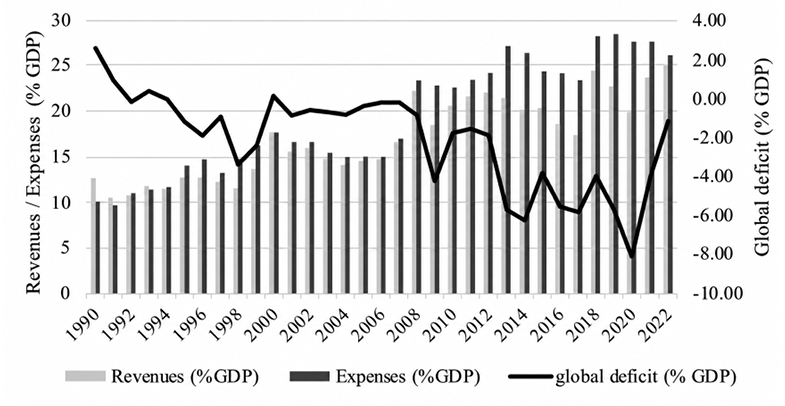
Note: Prepared by the authors based on fiscal sector statistics on an accrual basis from the Central Bank of Ecuador (2023).
Between 1982 and 1998, external debt rose from 18 % to 62 % of GDP, tax revenues dried up following the elimination of corporate income tax and the creation of special regimes for oil companies, and primary spending grew at an average annual rate of 4.6 % in real terms, financed by external loans and oil revenues that were never transformed into countercyclical savings. The result was the banking crisis of 1998-1999, leaving Ecuador with a fiscal deficit of 6.2 % of GDP and the economy in recession before the dollarization process began.
In 2000, the dollarization process took place, which brought a certain macroeconomic stability, controlling fiscal deficits that did not exceed 1 % of GDP at current prices. The new political line as of 2008 thanks to oil prices implemented an expansive fiscal policy due to growing social investment, spending on public infrastructure, and provision of resources aimed at meeting the basic needs of vulnerable social classes. This meant that the size of the State increased markedly (Mayoral, 2009), causing Fiscal deficits of up to 6.30 % of nominal GDP (De la Torre, 2021).
From 2017 onwards, as a result of fiscal indiscipline inherited from past regimes, social demonstrations, high taxes, spending cuts such as fuel subsidies, reduction of state apparatus, and the ravages of the COVID-19 pandemic, negative results ranging from 3.97 % to 8.11 % of nominal GDP were experienced (Casquete et al., 2022). These imbalances are driven by the ~30 % drop in oil prices and the subsequent collapse in oil demand following the COVID-19 health emergency (OECD, 2020). By 2022, it was decided to reorder the fiscal structure of the State by reducing spending and public employees, closing with a deficit of 1.26 % of GDP at current prices, being the lowest deficit result.
With respect to the explanatory variables, as shown in Table 2, total debt as a percentage of nominal GDP, although it presented an average of 40.78 %, stood at 72 % by 1999 and reached its lowest figure of 15 % in 2009, increasing progressively until it reached 60.40 % in 2022.
Table 2. Exploratory analysis of variables used in the modelling (1990–2022)
|
Variable |
Mean |
Std. Dev. |
Min |
Max |
Kurtosis |
skewness |
Normality (p-valor) |
|---|---|---|---|---|---|---|---|
|
Fiscal deficit |
–2.1875 |
2.5455 |
–8 |
3 |
2.571 |
–0.478 |
0.264 |
|
Total debt ratio |
40.7812 |
15.3659 |
15 |
72 |
2.131 |
0.038 |
0.541 |
|
Gini Coefficient |
0.4946 |
0.0375 |
0.45 |
0.59 |
2.463 |
0.545 |
0.130 |
|
Trade openness |
50.5937 |
7.8898 |
39 |
68 |
2.113 |
0.599 |
0.114 |
|
Electoral Democracy Index |
0.6527 |
0.0618 |
0.538 |
0.722 |
2.270 |
–0.266 |
0.101 |
|
Real GDP growth rate |
2.6562 |
3.2089 |
–8 |
8 |
2.843 |
–0.319 |
0.104 |
|
Political Corruption Index |
0.6774 |
0.0313 |
0.626 |
0.719 |
2.580 |
–0.265 |
0.096 |
|
Inflation |
18.0125 |
23.0980 |
–0.9 |
91 |
3.495 |
0.475 |
0.098 |
Note: estimates based on data obtained from various sources.
The real GDP growth rate in the last decade of the twentieth century, particularly between 1990 and 1998, the Ecuadorian economy had an average rate of 3.11 %, with a maximum of 4.30 % and minimum of 1.70 %. On the other hand, in 1999, the national economy decreased in real terms by 4.7 % due to the crisis in the financial sector and exchange market (Orellana, 2011). By 2000, economic activity recovered and achieved a slight real GDP growth rate of 1.10 %, which maintained this trend thanks to price stability, the increase in oil prices, strong public investment, and private consumption, achieving growth rates of 8.20 % and 6.40 % for 2004 and 2008, respectively (Banco Central del Ecuador, 2010). Between 2010 and 2022, it showed differentiated behaviour patterns, with growth rates of up to 3.50 % and lows of 1.20 % and 7.80 % (2016 and 2020).
In terms of inequality, in the last decade of the last century, income inequality in Ecuador measured by the Gini coefficient increased progressively from 45.50 to 58.60. Traditionally, Ecuador has been an exporter of natural resources with significant trade openness, which averaged 44 % of GDP between 1990 and 1999. In the 2000–2010 period, trade openness rose to 56.03 percentage points in reference to GDP, reaching a peak of 68.06 % in 2008. In 2011, it reached 64 % but was only 57.69 % in 2022 because of the complicated fall in the price of crude oil in 2014, the establishment of new tariffs, and the health emergency of 2020.
As for the institutional variables, the quality of a country’s democracy is key to the characterization of the regime that has power, so methods of democratization are evaluated according to the axes of the competitive electoral system and participation, political rights, and obedience to freedoms, which regulate the functioning of the State (Pachano, 2008). The score achieved by the electoral democracy index from 1990 to 1999 decreased from 0.725 to 0.692; that trend prevailed until the end of 2015, when a score of 0.540 was reached. As of 2016, the electoral principle that is based on political competitiveness and free participation had a turnaround: the indicator grew to 0.551. In 2022, a score of 0.657 over 1 was reached, revealing an increase in the strength and quality of the electoral system. With respect to political corruption for the period of analysis, this index fluctuated gradually, increasing to values above 0.70 between the years 2003 and 2016, then experiencing a decreasing trend from 2017, the year in which the lowest levels of political corruption were reported.
To estimate the effect of these variables on the behaviour of the fiscal deficit, we started by estimating the correlation between the explanatory variables to assess any possible multicollinearity issues, as shown in Table 2.
Table 2. Correlation between explanatory variables
|
Total debt ratio |
Real GDP growth rate |
Gini Coefficient |
Trade openness |
Electoral Democracy Index |
Inflation |
|
|---|---|---|---|---|---|---|
|
Total debt ratio |
1.00 |
|||||
|
Real GDP growth rate |
–0.50 |
1.00 |
||||
|
Gini Coefficient |
0.35 |
–0.06 |
1.00 |
|||
|
Trade openness |
–0.59 |
0.50 |
0.14 |
1.00 |
||
|
Electoral Democracy Index |
0.53 |
0.06 |
0.57 |
–0.22 |
1.00 |
|
|
Inflation |
0.58 |
–0.14 |
0.43 |
–0.17 |
0.56 |
1.00 |
|
Political Corruption Index |
–0.25 |
0.16 |
0.46 |
0.33 |
0.01 |
–0.03 |
Once the possible absence of multicollinearity among the explanatory variables had been assessed, the order of integration of the variables was determined in order to validate the assumptions of stationarity or non-stationarity of the series. The results of the unit root tests show that the variables of fiscal deficit, Gini coefficient, openness, electoral democracy, inflation, and political corruption are non-stationary (first order integrated), while the GDP growth rate is stationary.
To test for causality, as explained in the Methodology section, an ARDL model was estimated, the short- and long-term results of which, as well as the adjustment coefficient, are shown in Table 4.
Table 4. Estimation of the ARDL model for the short and long term for the Fiscal deficit.
|
Coefficient |
Standard error |
Statistic t |
confidence interval (95 %) |
|
|---|---|---|---|---|
|
Fiscal deficit adjustment (-1) |
–0.92160*** |
0.1535 |
–6.03 |
–1.2448 -0.6076 |
|
Long-term estimate |
||||
|
Real GDP growth rate (-1) |
0.2438** |
0.0923 |
2.64 |
0.05226 0.4354 |
|
Total debt ratio (-1) |
–0.0418 |
0.0329 |
–1,27 |
–0.1101 0.0265 |
|
Gini (-1) |
16.6724 |
11.6078 |
1.44 |
–7.4008 40.7457 |
|
Trade openness (-1) |
0.0191 |
0.0478 |
0.40 |
–0.0801 0.1183 |
|
Inflation (-1) |
0.0273* |
0.0137 |
1.98 |
–0.0012 0.05594 |
|
Electoral democracy (-1) |
23.266*** |
6.2088 |
3.75 |
10.390 36.1428 |
|
Political corruption (-1) |
–8.5103 |
9.2697 |
–0.88 |
–27.374 11.073 |
|
Short-term estimate |
||||
|
D Real GDP growth rate |
0.2258** |
0.0861 |
2.62 |
0.0471 0.4044 |
|
D Total debt ratio |
–0.0387 |
0.3425 |
–1.13 |
–0.1097 0.0323 |
|
D Gini |
15.439 |
11.379 |
1-36 |
–8.159 39.038 |
|
D Trade openness |
0.0177 |
0.0432 |
0.41 |
–0.072 0.10748 |
|
D Inflation |
0.0253* |
0.0144 |
1.76 |
–0.0045 0.0552 |
|
D Electoral democracy |
21.546*** |
6.8386 |
3.15 |
7.3637 35.728 |
|
D Political corruption |
–7.5477 |
8.9166 |
–0.85 |
–26.039 10.944 |
|
Constant |
–19.104*** |
5.704 |
–3.35 |
–30.934 -7.2749 |
|
Maximum likelihood |
–40.5921 |
|||
|
R2 |
0.7015 |
|||
|
VIF |
6.86 |
|||
|
Breusch-Godfrey |
0.1680 |
|||
|
White |
31.00 |
|||
|
Normality |
0.36 |
|||
|
Ramsey |
0.39 |
|||
|
CUSUM |
0.2054 |
|||
Note: the significance level indicates 1 % (***), 5 % (**), and 10 % (*).
The speed of adjustment of the Fiscal deficit complies with what is suggested in the literature, showing a value at unity (-0.92) that is negative and significant. This might demonstrate the existence of a cointegration relationship that was validated with Pesaran, Shin, and Smith’s bounds tests, as presented in Table 3. The tests corroborate the existence of a linear combination that cointegrates.
Table 3. Pesaran, Shin, and Smith’s Bounds Tests
|
I(0)-I(1) 10 % |
I(0)-I(1) 5 % |
I(0)-I(1) 2.5 % |
I(0)-I(1) 1 % |
|
|---|---|---|---|---|
|
F = 6.462 |
2.03 / 3.13 |
2.32 / 3.50 |
2.60 / 3.84 |
2.96 / 4.26 |
|
t = -6.032 |
–2.57 / -4.53 |
–2.86 / -4.57 |
–3.13 / -4.85 |
–3.43 / -5.19 |
The F-test and t-test allowed us to reject the null hypothesis of the non-existence of a long-term relationship, the former because the value of the F statistic is greater than all the upper limits and the latter because it produced a value lower than all the lower limits.
Thus, once the existence of an equilibrium relationship was confirmed using the bounds test, the next step was to break down the dynamics of the fiscal deficit into its short- and long-term components. To do this, the ARDL model was reparametrized in its error correction form (ECM), which allows us to observe, in a single equation, how much the deficit deviates from its equilibrium path in the short term and, at the same time, how long it takes to return to it. The so-called “speed of adjustment” measures the fraction of the deviation that is corrected in a single period. In our case, the estimated value was –0.9216 and was highly significant (p < 0.01), implying that, after a shock that pushes the deficit away from its equilibrium value, approximately 92 % of that gap is eliminated in the first year. The negative magnitude close to –1 indicates a rapid and almost complete adjustment in twelve months, which is consistent with Ecuador’s dollarization environment, where the inability to finance itself through monetary issuance forces the government to quickly correct imbalances through changes in spending or revenue.
To ensure that this estimate is reliable, it was subjected to a battery of diagnostics. The errors are not autocorrelated, the variance is homogeneous over time, the residuals follow a normal distribution, and there is no evidence of incorrect specification. In addition, the CUSUM confirms that the coefficients are stable during the sample period, and the variance inflation factor is below the conventional threshold of 10, ruling out multicollinearity issues.
From these results, it is then possible to corroborate the long-term relationship and estimate the short-term relationship, the former in levels and the latter in differences. For the long-term relationship, the real GDP growth rate and electoral democracy index were statistically significant in the sense that a higher GDP growth rate tends to reduce the deficit since, given that the deficit takes negative values, a lower deficit level would imply a figure close to zero on the left, as reported in the literature. With respect to the second variable, higher levels of democracy also reduce the deficit because the possibility of entering the political budget cycle is minimized.
Regarding the short-term model in terms of differences, the results indicate similar behaviours in terms of the GDP growth rate and electoral democracy index. However, the difference in inflation also has a significant effect, so that as inflation increases compared to the previous year, the fiscal deficit is reduced as a result of the monetary financing of said deficit, at least in the first years of the study period before Ecuador’s dollarization.
As expected, lower levels of political corruption are associated with smaller fiscal deficits. Nonetheless, it was not statistically significant in the short or long term. When evaluating the validity of the estimates, the tests indicate that there is no evidence of autocorrelation, heteroscedasticity, normality of residuals, stability, or multicollinearity, thus the model can robustly explain the behaviour of the Fiscal deficit.
With regard to structural shocks, the period 1990-2022 covers events that abruptly altered Ecuador’s fiscal path: the banking crisis (1999), dollarization (2000), the oil boom (2008), the collapse of prices (2014), and the health emergency (2020). To verify that the ARDL coefficients are not biased by these breaks, the CUSUM test was applied to the recursive residuals, showing that the statistic remains within the 5 % bands throughout the sample, implying parameter stability. This indicates that although structural shocks exist, the cointegration relationship is robust and is not invalidated by the large shocks of the period analysed.
5. Discussion
The results of the study show that economic growth has a negative and significant impact on the fiscal deficit, both in the short and long term. Specifically, an increase in real Gross Domestic Product (GDP) is associated with a reduction in the fiscal deficit. These findings are consistent with the theory of Barro (1979), who argues that economic growth generates an increase in tax revenues, which allows the government to reduce its fiscal deficit without increasing debt. Moreover, in line with the studies of Woo (2003) and Cifuentes et al. (2022), sustained economic growth has a positive effect on reducing fiscal deficits, as it generates higher tax revenues and reduces the need for expansionary fiscal policies.
However, Stein (2010) pointed out that, in Latin America, countries tend to apply procyclical fiscal policies, where the increase in revenue during periods of economic growth does not always translate into a reduction in the deficit, but rather spending tends to increase proportionally or even excessively. Although the results of this study show a negative relationship between economic growth and fiscal deficit, this could be moderated by the type of fiscal policies implemented, especially if they are expansionary during periods of growth.
Inflation also shows a significant impact on the fiscal deficit, particularly in the short term. The results indicate that an increase in inflation is associated with a reduction in the fiscal deficit, because the government uses monetary issuance as a tool to finance the fiscal deficit, a phenomenon that is in line with the theories of Friedman (2005) and Sargent & Wallace (1981), who state that fiscal deficits financed through money creation lead to an increase in inflation.
This finding is consistent with the studies of Reinhart & Rogoff (2010), who stress that the use of inflation as a method of financing has negative effects on long-term economic stability. Importantly, while the use of inflation may provide a temporary solution to the fiscal deficit, in the long run it is not sustainable, as it erodes purchasing power and confidence in the currency.
The study also evaluates the impact of economic inequality, as measured by the Gini coefficient, on the fiscal deficit. The results suggest that greater inequality is associated with an increase in the fiscal deficit, which supports the view of Tanzi & Schuknecht (2000), who explain that economic inequality drives the demand for redistributive public policies, which can generate higher government expenditures and, therefore, higher deficits.
However, the results also show that this effect can be moderated by institutional quality. In countries with strong institutions, resource redistribution is more efficient and less costly, which can reduce the pressure on the fiscal deficit. This result is consistent with the studies of Gnimassoun & Do Santos (2020), who emphasize that institutional quality plays a crucial role in how public resources are managed and how economic benefits are distributed.
Regarding electoral democracy, the results obtained in this study show that higher democratic quality is associated with a significant reduction in the fiscal deficit, in line with the findings of Alesina & Perotti (1995) and Persson & Tabellini (2003). In their theory, they argue that more robust democracies, with transparent and accountable electoral systems, limit the manipulation of public spending by politicians, which contributes to more responsible fiscal management.
This quantitatively strong effect coincides with the evidence presented by de Haan and Klomp (2013), who conclude that countries moving toward consolidated democracies, as measured by fair electoral competition, media pluralism, and legislative oversight, reduce their cyclically adjusted deficit by an average of 1.5-2.0 points. In Latin America, Brender & Drazen (2005) show that political-budgetary cycles disappear precisely when the Electoral Competition Index (ICE) exceeds the threshold of 0.65, a threshold that Ecuador only reached in 2017. Thus, the negative coefficient found here does not reflect a mere correlation: it captures the dampening effect that a more inclusive democracy has on the procyclical bias of spending, limiting pre-election increases in payroll and subsidies which, according to evidence from 11 Ecuadorian governments (1990-2022), account for an average of 42 % of the annual variation in the deficit.
This behaviour also aligns with the political-economic cycle theory put forward by Nordhaus (1975), which suggests that governments in less consolidated democracies tend to increase public spending in pre-election years to gain electoral support, which can lead to higher fiscal deficits. In Ecuador, as electoral democracy has improved, there has been a tendency to reduce fiscal deficits, suggesting that strengthening democratic institutions may be a key factor for long-term fiscal sustainability.
Political corruption is another variable analysed in this study. Although the results show a negative relationship between corruption and fiscal deficits, political corruption is not found to be statistically significant in the model in the short or long run. This may indicate that, despite efforts to improve corruption levels in Ecuador, these have not translated into a significant reduction in the fiscal deficit, which could be due to the lack of effective implementation of the necessary institutional reforms.
This finding partially contradicts the studies of Mauro (1995) and Acemoglu et al. (2001), who argue that corruption has a direct and negative impact on the fiscal deficit, as it reduces government efficiency in tax collection and resource allocation. However, the results of this study also suggest that, although corruption is a crucial factor in fiscal management, other elements, such as inflation and economic growth, have a more immediate impact on the fiscal deficit in Ecuador.
The findings of this study have important implications for fiscal policy in Ecuador. First, sustained economic growth should be a key objective of fiscal policy, as it has a positive impact on fiscal deficit reduction. To achieve this, it is essential to diversify the economy and reduce dependence on oil revenues, as suggested by Tanzi & Schuknecht (2000) and Agnello & Sousa (2009).
Second, fiscal policy should focus on improving institutional quality, particularly by fighting corruption and strengthening electoral democracy. Reforms that promote transparency, accountability and government effectiveness can be key to improving fiscal sustainability. In this sense, the results suggest that a more robust democratic system and better control of corruption can be key instruments for reducing fiscal deficits.
6. Conclusions
The analysis carried out using the ARDL model for the period 1990-2022 provides evidence that Ecuador’s fiscal deficit is not an isolated phenomenon, but rather the result of a long-term equilibrium relationship in which the quality of democratic institutions and the pace of economic expansion act as the main stabilizers. In quantitative terms, an improvement of just 0.1 points in the electoral democracy index reduces the deficit by 2.3 percentage points of GDP, while each additional point of real GDP growth cuts the imbalance by 0.24 percentage points. The magnitude of these coefficients exceeds that of any other determinant included in the model and demonstrates that strengthening fair electoral competition, legislative oversight, and budgetary transparency is not merely a political objective, but the most powerful fiscal tool available to the country.
The estimated speed of adjustment implies that 92 % of any deviation from equilibrium is corrected within twelve months, a pace significantly faster than that observed in economies with an independent central bank. This result confirms that dollarization acts as an almost instantaneous discipline mechanism: by eliminating the possibility of financing through monetary issuance, it forces the government to adjust spending or increase revenue in the same budget year. In practice, this gives the Ministry of Finance very little room for manoeuvre and makes institutional quality a strategic asset: the more robust the electoral democracy, the less temptation there is to use discretionary spending for clientelist purposes and, therefore, the faster the return to fiscal equilibrium.
The effect of inflation, although statistically significant only in the short term, has an important symbolic value: it constitutes empirical evidence that, before 2000, seigniorage was used as a temporary financing valve. With the adoption of the dollar, that channel disappears, so that the adjustment must come exclusively from the real side of the budget. This reinforces the need to maintain a consistent anti-inflationary policy and not to resort to indexation mechanisms that could reintroduce price pressures.
Finally, the absence of a statistical effect of political corruption should not be interpreted as a license to relax transparency efforts. Rather, it reflects that in the sample analysed, the level of electoral democracy already captures much of the variation in the quality of institutions.
Based on the approach taken, the limitations of the research are associated with an annual sample of 33 observations, which prevents the modelling of multiple breaks with regime-switching techniques; the absence of quarterly data on institutional quality that would allow for the analysis of intra-annual political cycles; possible endogeneity between deficit and debt that was not addressed with instrumental variables; and the omission of sub-national fiscal factors and public enterprises.
Given these limitations, it is suggested, for example, to expand the frequency with post-2000 quarterly series and use structural vector autoregression (SVAR) with sign restrictions, and to integrate data on intergovernmental transfers and state-owned enterprise balance sheets to construct a consolidated measure of the deficit that more accurately reflects the total fiscal effort of the Ecuadorian state.
Funding
This research is part of the project “Sustainable Development and Fiscal Decentralization,” funded by the Universidad Nacional de Chimborazo
REFERENCES
., ., & . (2001). The Colonial Origins of Comparative Development: An Empirical Investigation. American Economic Review, 91(5), 1369-1401. DOI: https://doi.org/10.1257/aer.91.5.1369
., & . (1995). The Political Economy of Fiscal deficits. Staff Papers (International Monetary Fund), 42(1), 1–31.
. & . (2009). The determinants of public deficit volatility. Working Paper Series 1042, European Central Bank. https://www.ecb.europa.eu/pub/pdf/scpwps/ecbwp1042.pdf
. & . (2013). Political, Institutional, and Economic Factors Underlying Deficit Volatility. Review of International Economics, 21(4), 719-732. https://doi.org/10.1111/roie.12066
., & . (2012). Political determinants of Fiscal deficit in Pakistan: An empirical investigation. HWWI Research Paper, No. 135, 1-21. https://hdl.handle.net/10419/67941
., & . (2023). Institutional Approach to the Fiscal deficit: An Empirical Analysis. SAGE Open, 13(2), 1-9. https://doi.org/10.1177/21582440231171297s
. (2010). La economía ecuatoriana luego de 10 años de dolarización. Quito: Dirección General de Estudios. https://contenido.bce.fin.ec/documentos/PublicacionesNotas/Notas/Dolarizacion/Dolarizacion10anios.pdf
. (2022). Informe de la evolución de la economía ecuatoriana en 2021 y perspectivas 2022. Quito: Subgerencia de Programación y Regulación.
., & . (2017). Impact of governance on Fiscal deficit in developing countries. Theoretical and Applied Economics, 2(611), 111-130.
. (1979). On the Determination of the Public Debt. Journal of Political Economy, 87(5), 940-971.
., & . (2009). Economic, Political and Institutional Determinants of Fiscal deficits in the European Union. Casio Working Paper Series No. 2611. http://dx.doi.org/10.2139/ssrn.1379604
., & . (2020). El efecto de la política fiscal en las elecciones de América Latina durante el periodo 1980-2016. Revista del CLAD Reforma y Democracia, (77), 37-72.
., & . (2005). Political budget cycles in new versus established democracies. Journal of Monetary Economics, 52(7), 1271-1295. https://doi.org/10.1016/j.jmoneco.2005.04.004
. & . (2008). Business Cycles and Fiscal Policies: the Role of Institutions and financial Markets. Working Papers Central Bank of Chile, 481, Central Bank of Chile.
. & . (2011). Sustainability of Latin American Fiscal Deficits: A Panel Data Approach. Borradores de Economía 9106, Banco de la Republica.
., ., & . (2022). Teorías, modelos y estrategias de desarrollo en América Latina y El Caribe. Períodos presidenciales: Lenin Moreno (2017-2021). Journal of Business Sciences, 4(18), 49-59. https://doi.org/10.53734/eidea.vol4.id267
., ., & . (2022). Determinants of local government deficit: evidence from Spanish municipalities. Heliyon Scientific Journal, 8(12), 1-11. https://doi.org/10.1016/j.heliyon.2022.e12393
. (2017). Determinants of Fiscal Deficit in Conflict-affected States in Africa. International Journal of Economic Policy Studies, 12, 69-95. https://doi.org/10.1007/BF03405769
., & . (2013). Conditional political budget cycles: a review of recent evidence. Public Choice, 157(3/4), 387–410. http://www.jstor.org/stable/24507620
. (2021). El manejo fiscal: revisión técnica de su realidad en el Ecuador, 2000-2019. Revista Internacional de administración, 9, 55-79. https://doi.org/10.32719/25506641.2021.9.3
. (2017). Identifying the Relationships between Fiscal deficit and Selected Macroeconomic Variables: A Study of Sri Lanka During the Postliberalization Era. 13th International Conference on Business Management (ICBM). http://dx.doi.org/10.2139/ssrn.2910354
. (2005). Deficits and Debt in the Short and Long Run. National Bureau of Economic Research, Working Paper 11630, 1-39. https://doi.org/10.3386/W11630
., & . (2020). Robust structural determinants of public deficits in developing countries. Applied Economics, 53 (9), 1052-1076. https://doi.org/10.1080/00036846.2020.1824063
. (2023). The Determinants of Fiscal Deficit in South Africa: A Bayesian Vector Autoregressive Approach. International Journal of Economics and Financial Issues, 13(4), 30–36. https://doi.org/10.32479/ijefi.14433
., . & . (1999). Governance Matters. https://ssrn.com/abstract=188568
. (1995). Corruption and Growth. The Quarterly Journal of Economics, 110(3), 681-712. https://doi.org/10.2307/2946696
., & . (2020). The determinants of fiscal deficits: a survey of literature. International Review of Economics, 67, 403-417. https://doi.org/10.1007/s12232-020-00348-8
. (2009). Desde los años 50 hasta el gobierno de Rafael Correa. Nueva Sociedad, 221, 120-136. https://nuso.org/autor/fernando-martin-mayoral/
., ., & . (2013). The Economic Determinants of Fiscal deficits in South Africa. Mediterranean Journal of Social Sciences, 4(13), 561-569.
., & . (2023). Asymmetric Impacts of Public Debt on Economic Growth: Empirical Evidence From Vietnam. International Journal of Professional Business Review, 8(5), e02157. https://doi.org/10.26668/businessreview/2023.v8i5.2157
., & . (2021). Fiscal Policy, Institutional Quality, and Public Debt: Evidence from Transition Countries. Sustainability, 13(9), 1-15. https://doi.org/10.3390/su131910706
. (1975). The Political Business Cycle. Review of Economic Studies, 42(2), 169-190. https://doi.org/10.2307/2296528
. (1990). Institutions, Institutional Change and Economic Performance. Cambridge: Cambridge University Press.
., & . (2018). Political economy of fiscal deficits in a democracy. Economia, 19(1), 12-23. https://doi.org/10.1016/j.econ.2017.10.002
. (2011). Hechos estilizados del ciclo económico de Ecuador: 1990-2009. Revista Universitas, 15, 53-84. https://doi.org/10.17163/uni.n15.2011.02
. (2008). Calidad de la democracia y colapso del sistema de partidos en Ecuador. México D.F.: FLACSO. https://www.flacsoandes.edu.ec/agora/calidad-de-la-democracia-y-colapso-del-sistema-de-partidos-en-ecuador
., & . (2003). The economic effects of constitutions. MIT Press.
. & . (2010). Growth in a Time of Debt. American Economic Review, 100 (2): 573–78. DOI: https://doi.org/10.1257/aer.100.2.573
. (2016). Public Debt Policies. CESifo Forum, 17(1), 48-51
., & . (1988). Elections and Macroeconomic Policy Cycles. Review of Economic Studies, 55(1), 1-16.
., & . (2017). Impact of Institutions on Fiscal deficit: The Case of Pakistan. NUML International Journal of Business & Management, 12(1), 77-88.
., & . (1981). Some Unpleasant Monetarist Arithmetic. Federal Reserve Bank of Minneapolis Quarterly Review, 5(3), 1-17. https://doi.org/10.21034/qr.531
. (2010). A Critique of the Literature on the US Financial Debt Crisis. CESifo Working Paper Series No. 2924. http://dx.doi.org/10.2139/ssrn.1545722
., & . (2000). Public Spending in the 20th Century: A Global Perspective. Cambridge University Press. https://doi.org/10.1017/CBO9780511625800
., & . (2011). Public debt and the limits of fiscal policy to increase economic growth. European Economic Review, 66, 1-15. https://doi.org/10.1016/J.EUROECOREV.2013.11.003
& . (2025).Fiscal consolidations in developing countries with a Latin America focus: The role of inequality, informality and corruption, Journal of Macroeconomics, 84, 103675, https://doi.org/10.1016/j.jmacro.2025.103675.
(2023a). Conjunto de datos. https://www.v-dem.net/
(2023b). Methodology. Gothenburg: University of Gothenburg. https://v-dem.net/documents/26/methodology_v13.pdf
. (1991). A note on the empirical effectiveness of formal fiscal restraints. Journal of Public Economics, 44(2), 99-110.
. (2004). El origen político del déficit fiscal en Colombia: el contexto institucional 20 años después. Documento CEDE, 20, Universidad de los Andes.
. (2003). Economic, political, and institutional determinants of public deficits. Journal of Public Economics, 87, 387-426. https://doi.org/10.1016/S0047-2727(01)00143-8